Winter Warrior Finland – Organizer’s Story
Sections
- Intro
- It all started with one careless sentence
- First steps into the unknown
- The name is born: Winter Warrior Finland
- The first trip to Ylläs
- National park rules and the first lesson
- From an idea to task lists
- The first registration
- Winter Warrior Finland 2018
- Volunteer spirit and community
- Winter Warrior 2019
- The third year—and the world comes to a halt
- Return to normal
- Moments along the way
- The final year in Ylläs
- The idea of Tampere and a social media pause
- The groundwork begins
- Planning begins in Tampere
- The route master’s challenges
- The race is over
- Financial realities
- Winter Warrior Finland 2026
- Our dynamic and division of roles
- The core team
- Looking back
Winter Warrior Finland – Organizer’s Story
Sections
- Intro
- It all started with one careless sentence
- First steps into the unknown
- The name is born: Winter Warrior Finland
- The first trip to Ylläs
- National park rules and the first lesson
- From an idea to task lists
- The first registration
- Winter Warrior Finland 2018
- Volunteer spirit and community
- Winter Warrior 2019
- The third year—and the world comes to a halt
- Return to normal
- Moments along the way
- The final year in Ylläs
- The idea of Tampere and a social media pause
- The groundwork begins
- Planning begins in Tampere
- The route master’s challenges
- The race is over
- Financial realities
- Winter Warrior Finland 2026
- Our dynamic and division of roles
- The core team
- Looking back
Intro
I said it to my husband Simo almost without thinking, after he came home from the Tough Guy Competition in England. At the time, I had no idea that sentence would lead to a project lasting years, involving dozens of volunteers, hundreds of participants and ultimately leading to this story.
Winter Warrior Finland was a winter obstacle course race that Simo and I organized, first in Ylläs and later in Tampere. I am Maria, one of the event organizers. This is the story of what happened after that sentence.
I originally wrote this story mainly for myself, as a way to preserve memory and perhaps also to process the decision to stop organizing the race. However, I decided to share it, as I thought it might bring value or encouragement to someone else who is considering organizing a similar event.
It all started with one careless sentence
The story began just over nine years ago, when Simo came home from the Tough Guy Competition in England. His group of friends, Sikaniskat, had been traveling there to compete for several years already. Tough Guy was held in January in freezing conditions, and it is considered the mother of these types of OCR races.
I remember well when Simo went there for the first time. It honestly sounded quite intimidating. I would have liked to follow the race from home somehow, but there was no live tracking. Nothing was updated on social media during race day, either.
That stayed in my mind. Perhaps that is why it later became important for us that Winter Warrior could be followed, at least in some way, through social media.
In 2017, Simo returned home from Tough Guy again. He was excited and told me how he and his friends, along with other racers, had been talking about how great it would be to organize a similar race in a place with a real winter. In England, it was cold and miserable, but not the kind of winter we have in Finland—no snow, no ice.
That was when I opened my mouth and said the sentence we have returned to many times since:
“Well, let’s organize one then, since you’ve been dreaming about it?”
It was an easy sentence to say.
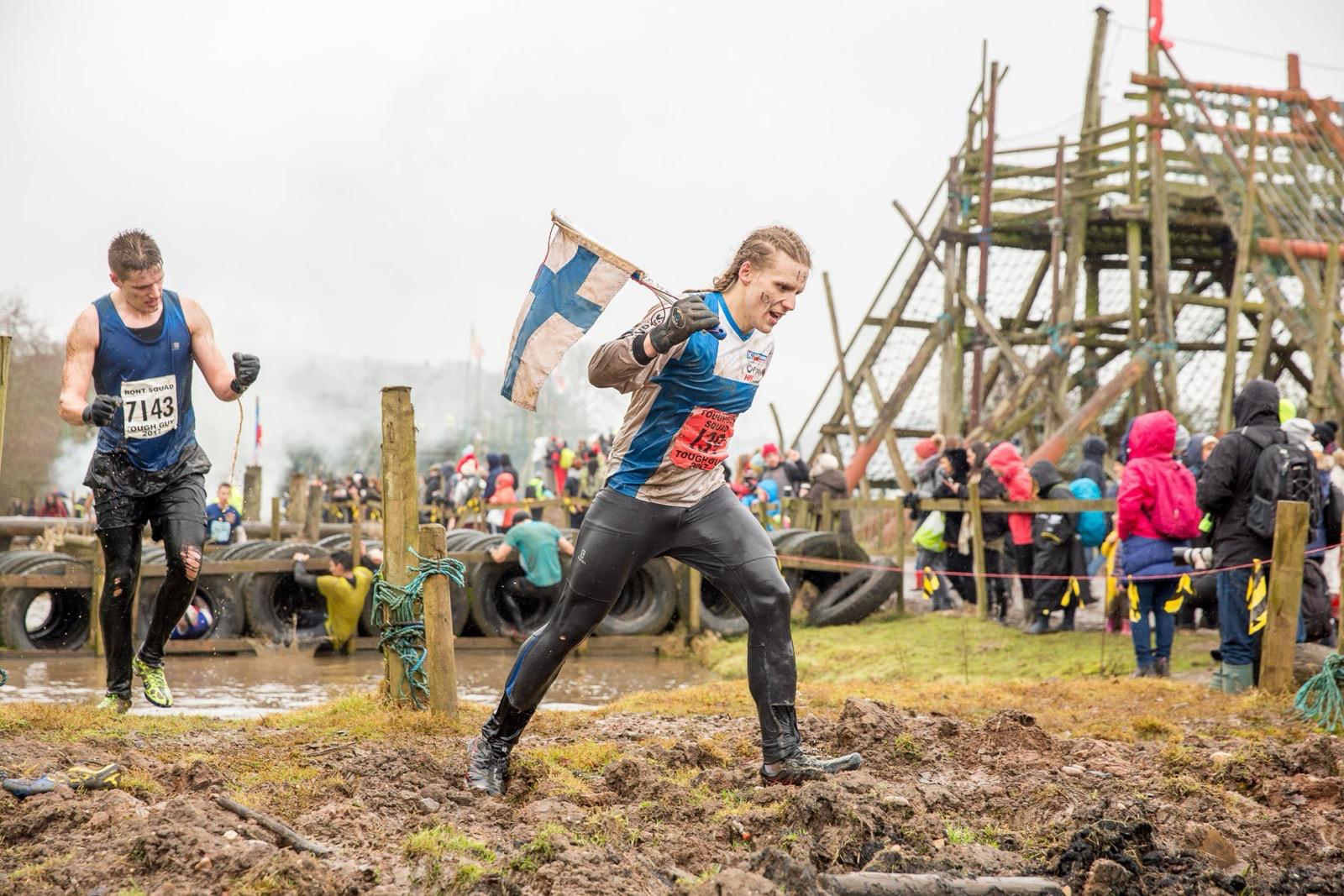
Simo running in the Tough Guy competition
First steps into the unknown
Neither of us had ever organized a sports race, nor really any larger event at all. We had no real understanding of what we were getting into. We simply decided to start figuring things out one step at a time.
At that stage, we also did not yet fully understand what it would mean in practice. We both had full-time jobs in completely different fields, and Winter Warrior began to take shape during evenings, weekends, and holidays.
At the time, we were in Helsinki spending a long weekend at a tango event. In the end, there was not much dancing, as we found ourselves sitting in our hotel room with our laptops open, trying to figure out how such a race could be organized.
The first question was where the race could take place. From the very beginning, it was clear that a proper winter would be required: snow, hilly terrain, and a lake. The lake was essential, as an ice-hole obstacle had been a central element of the idea from the start. At some point, it was even given a fitting name: I Scream Tunnel.
Simo began studying the map and found a location in Ylläs where a lake lay between two fells. At least on the map, it looked perfect. Neither of us, however, had ever been there.
Fortunately, we knew someone who ran a cabin business in the area. We turned to him for our first pieces of advice, as we did not really know where to begin.
Soon we learned that the area belongs to Pallas–Yllästunturi National Park. So I called the park director and explained our idea of organizing a running race there. He may have been slightly skeptical, but still positive.
“There’s well over a meter of snow in the forest. If you want to go running there, go right ahead,” he laughed.
In reality, obtaining the necessary permits was, of course, not quite that simple. But after that call, it felt like the race could actually be possible. Before that, however, we would need to travel to Ylläs to see the area for ourselves and take photos before the snow would melt.
The name is born: Winter Warrior Finland
The name of the race—and with it, the entire brand—also began to take shape during that same weekend as we searched the map for a suitable race location.
The entire planning started from one simple question: what kind of race would Simo himself want to take part in?
The answer was clear. The race should be genuinely tough—the kind that gives you the opportunity to truly challenge yourself. Simo has always enjoyed that strange but familiar feeling of pushing himself to the limit and still realizing he can keep going.
We wanted to create a race that would be tough enough for someone to be willing to travel from abroad, all the way to Lapland, to take part.
Winter was at the core of the whole idea from the very beginning, even though we were well aware that organizing a summer race would have been easier and probably also more financially sensible.
The word “Warrior,” on the other hand, represented an attitude for us. Not something warlike, but resilience, courage, and integrity. The idea that a person is capable of more than they believe—and that strength is also reflected in how you treat others.
The name eventually became Winter Warrior Finland. The slogan was developed: The toughest OCR above the Arctic Circle.
We reserved a domain for the website and even registered a trademark. At that point, the project started to feel real. Simo initially got the idea for the logo from a matchbox, but fortunately, we decided to have a proper logo designed by a professional we knew.
The next challenge, however, was already in front of us: how do you market a race like this? We didn’t yet have a race. No photos. No videos—and essentially nothing to show people what we were trying to create.
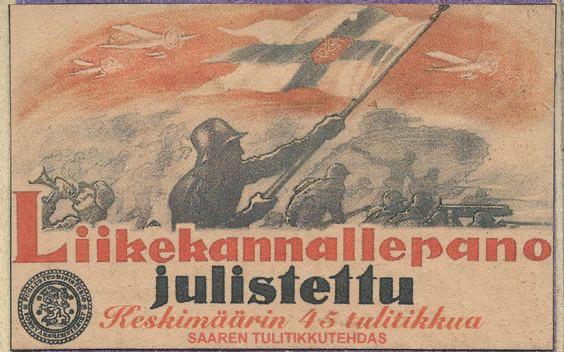
The matchbox that inspired our logo
Our eventual logo
The first trip to Ylläs
Our first trip to Ylläs took place in April. We were able to explore the area, and Simo quickly began to visualize the race route.
Kesänkijärvi immediately felt like the perfect location. The lake sat naturally along the middle section of the route, with two fells rising around it: Kellostapuli and Kesänki. The scenery was stunning. Up on the fells, you just wanted to pause for a moment and breathe in the silence. From the top, you could see all the way down to the lake, and even then, the idea emerged that spectators might somehow be able to follow the race from the slopes at a distance.
We arranged the race center at Kellokas Nature Centre. There, we also met the head of tourism for Ylläs, who gave us a lot of valuable advice. Many of his comments have come back to mind several times since.
He put it very directly:
“Creating a new event requires a lot of work. The third year reveals the truth—if the event is going to take off, that is when it happens.”
He also spoke frankly about the financial realities of events: participation fees cover the costs, and the organizers’ compensation comes from sponsors—if it comes at all.
He also emphasized the importance of volunteers. At the same time, it became clear that finding local volunteers would not be easy. In a resort area, there are few permanent locals, and they are already busy with tourists.
In Ylläs, we spent long days outdoors. We explored the route, filmed material, and tried to gather anything we could later use to market the race. There was still enough snow for the landscape to look wintry, even though parts of the fell slopes were already bare rock.
On later trips, Simo and I also simply enjoyed being able to wade through deep snow and act like children. We filmed all kinds of silly videos and experimented with how you can even move through snow more than a meter deep. For those living in southern Finland, snow like that is nowadays mostly a childhood memory.
I love hiking and being outdoors. Especially in winter, being outside in Lapland is something truly special to me.
Only much later did I realize one ironic thing: organizing a race is at least 90 percent sitting in front of a computer. I have never moved as little or spent so little time outdoors as during the first years of Winter Warrior.
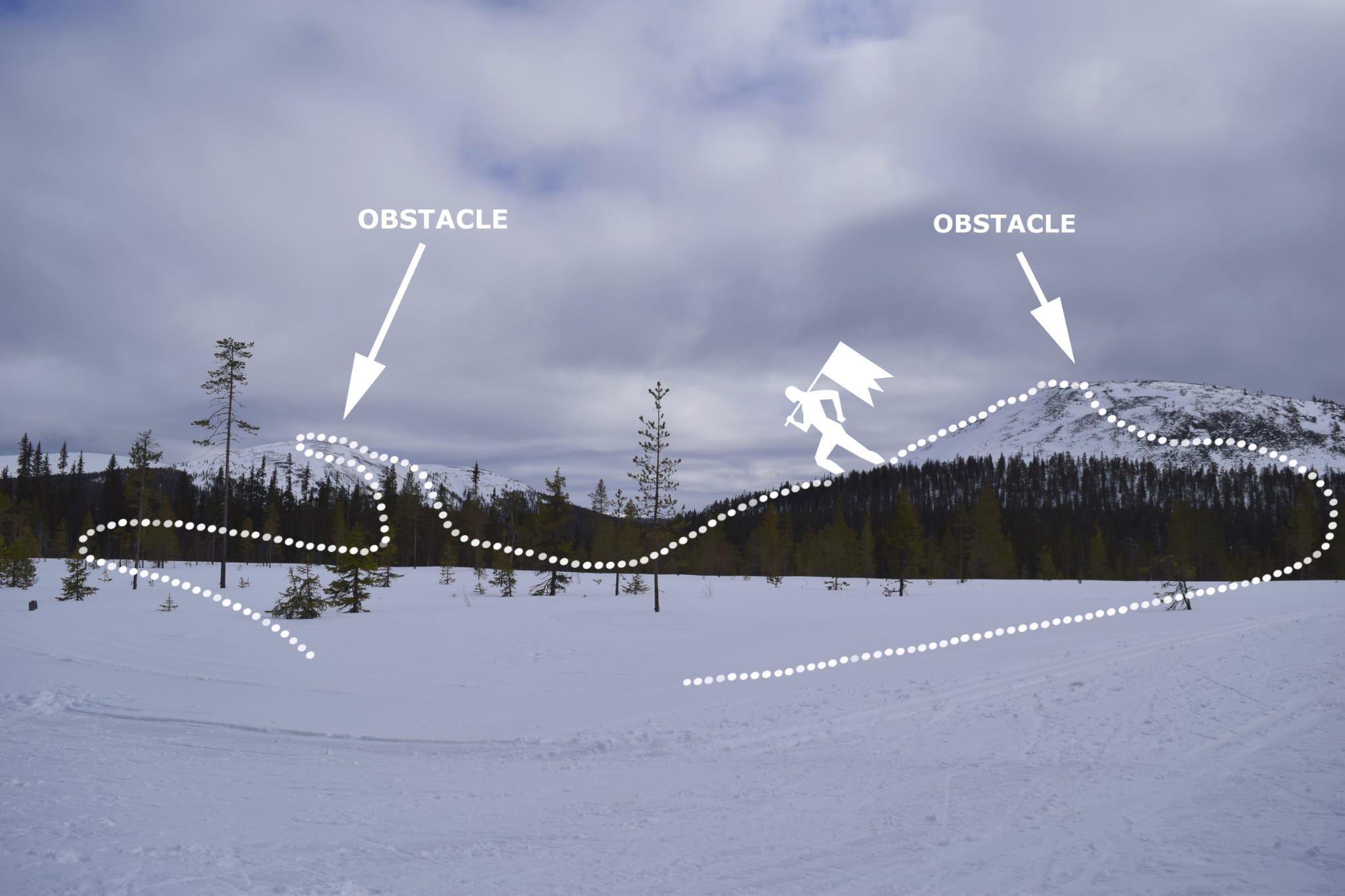
Year 2017, the route is taking shape
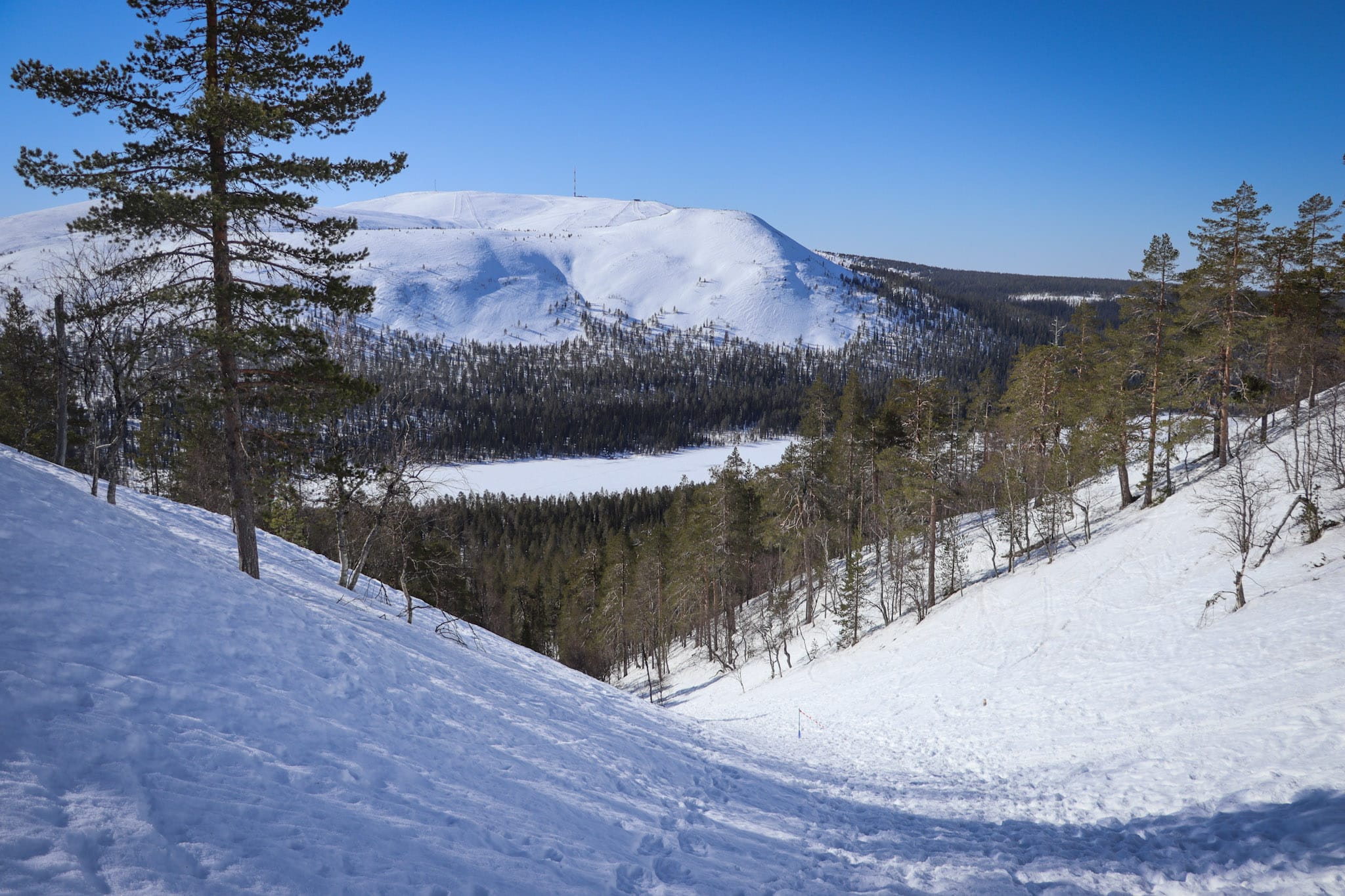
Scenery from the upper part of Pirunkuru. Kesänkijärvi and Kellostapuli in the background.
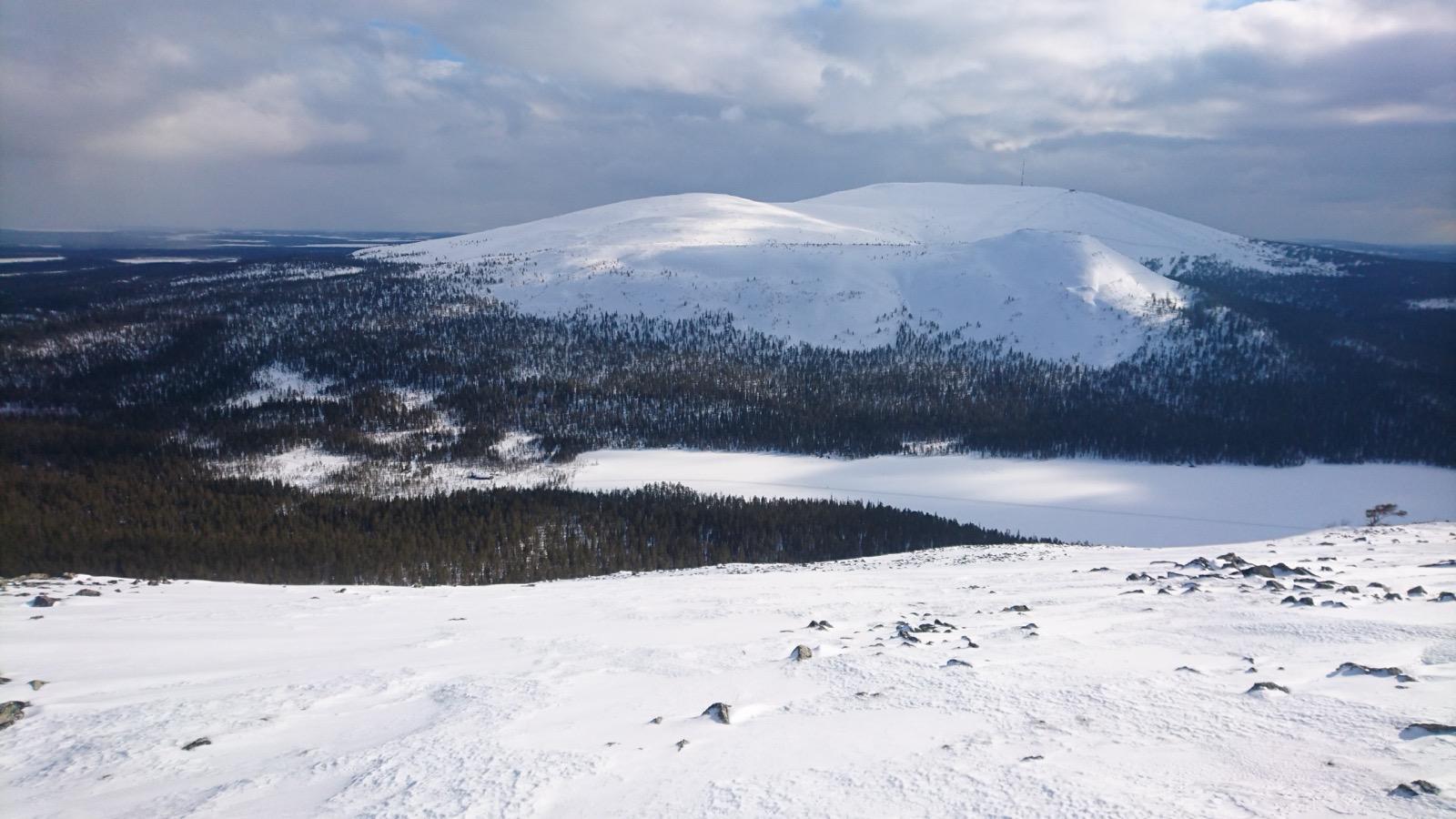
Same direction from the top of Kesänkitunturi. Kesänkijärvi, Kellostapuli and Yllästunturi in the background.
National park rules and the first lesson
From the very beginning, it was important to us to respect and take care of nature. Operating in a national park naturally emphasized this even more.
Winter protects nature in many ways, and that was also one of the reasons why organizing the race was possible in the first place. Even so, there were many restrictions involved, and at the beginning we did not get everything quite right.
One instructive situation came up early on when we were filming a marketing video. We had been shooting material in a snowy landscape and ran through one section completely unaware that we were in an area where protected moss grows.
The area was not marked in any way, and movement there was not otherwise restricted during winter. So we did not realize we had done anything wrong.
After we had published the video and the first information about the upcoming race in June, we were asked to remove the video.
It was a difficult situation. We essentially had exactly one marketing video. Filming a new one was no longer possible, as the snow had already melted.
Fortunately, after discussions, we reached an agreement and were allowed to use the video we had filmed. At the same time, we received a valuable lesson in how careful you need to be when operating in a national park.
From an idea to task lists
There were a huge number of things to figure out, and they appeared one by one. Fortunately, among Simo’s sports friends and our own circle, there were many people who got excited about the idea. Gradually, we formed a volunteer group of about 10–20 people who were willing to travel to Lapland to help organize the race. Some also took part in the planning, which helped a lot.
In the end, however, that was only a small part of the whole.
We had to build a website and open social media channels. Figure out permits and other bureaucracy. Design medals and T-shirts and find suppliers for them. Decide how registration would be handled and how timing would be implemented during the race.
What about marking the route? Or the obstacles?
In addition, we had to consider what kind of partners we would need and where to find them. How to manage communication with different parties, and how to market the event in the first place.
And of course, one important thing: photographers. For participants, it is important to get photos to share, and for us it was clear that we would also need material from the race to market the following year.
Then there was a long list of other practical questions. How do we get enough volunteers? How do we arrange their accommodation?
The race was essentially self-funded, and the budget was small. Sponsors were a category of their own. For a new event, securing them was very difficult in practice. Product sponsors, however, were possible to find—as long as you kept reaching out to enough companies. For example, we received prizes as well as drinks to distribute to participants at the finish.
The first registration
Registration finally opened on September 1. We promoted it on social media and decided to raffle a Winter Warrior running shirt among those who registered during the first week. We thought a small incentive might help get registrations moving.
Tapio from Vaasa had come across the race advertisement. He thought a race like this would surely fill up quickly, so he registered immediately when registration opened.
After the first week, we carried out the draw. Tapio won. He was surprised and happy about it.
For us, the raffle was quite simple to execute.
Tapio was the only one who had registered.
In the first race, Tapio ran with bib number 1. That became a tradition. He has run with the same number in every Winter Warrior race, and he has not missed a single year.
In later years, Tapio’s son has also taken part. Stories like these have, over the years, given us the strength to continue organizing the race.
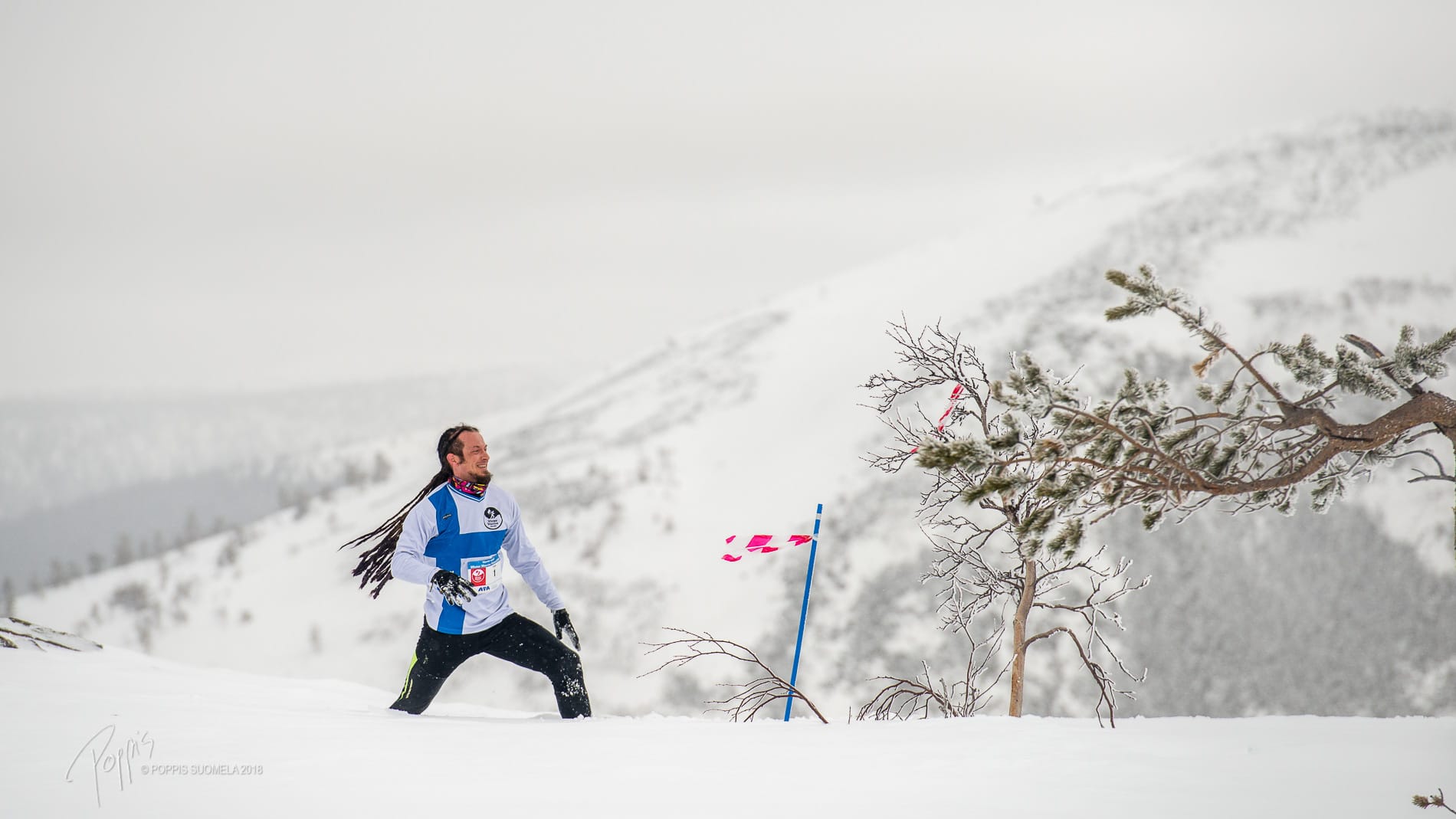
Tapio in the 2018 race, competing as number 1.
Winter Warrior Finland 2018
The first race took place on April 21, 2018. There were 37 participants from five different countries.
The number of participants was not large, but we had still managed to attract racers from across Europe to Lapland. That immediately brought an international atmosphere to the event and strengthened the feeling that the idea of a winter OCR race was not impossible after all.
One amusing moment comes to mind from the starting line.
The participants were waiting eagerly and nervously for the start signal, ready to sprint off. We were moving around the start area wearing snowshoes, and everything looked as if running on the snow would be perfectly normal.
When the start signal was given, the participants took a couple of steps—and then their legs sank into snow more than a meter deep.
The long starting stretch ended up being completed by crawling.
Already in the first race, the flag bearer tradition was included. The idea had originally started years earlier as a playful competition. Simo’s Sikaniska group came up with the idea of carrying the Finnish flag in races with a simple rule: the flag belonged to the one who reached the finish first. If you overtook the flag bearer, you could take the flag for yourself.
In Winter Warrior, we decided to make it part of the race. For each country represented, a flag was prepared. When the first participant from that country reached the flag near the end of the course, they could take it and carry it toward the finish. There were still obstacles on the final stretch, and only at the finish line was it decided who would become the flag bearers.
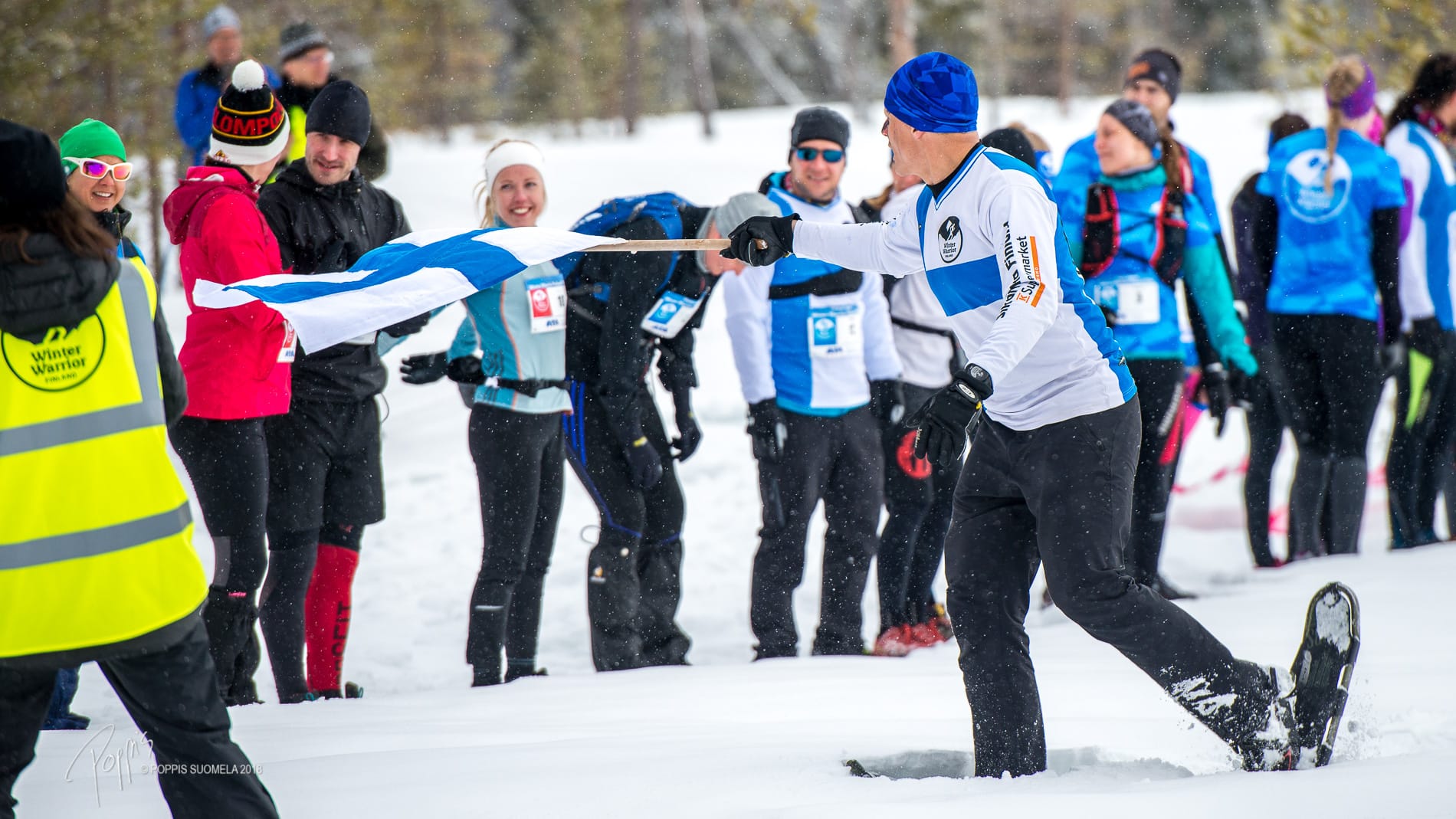
Atmosphere at the starting line
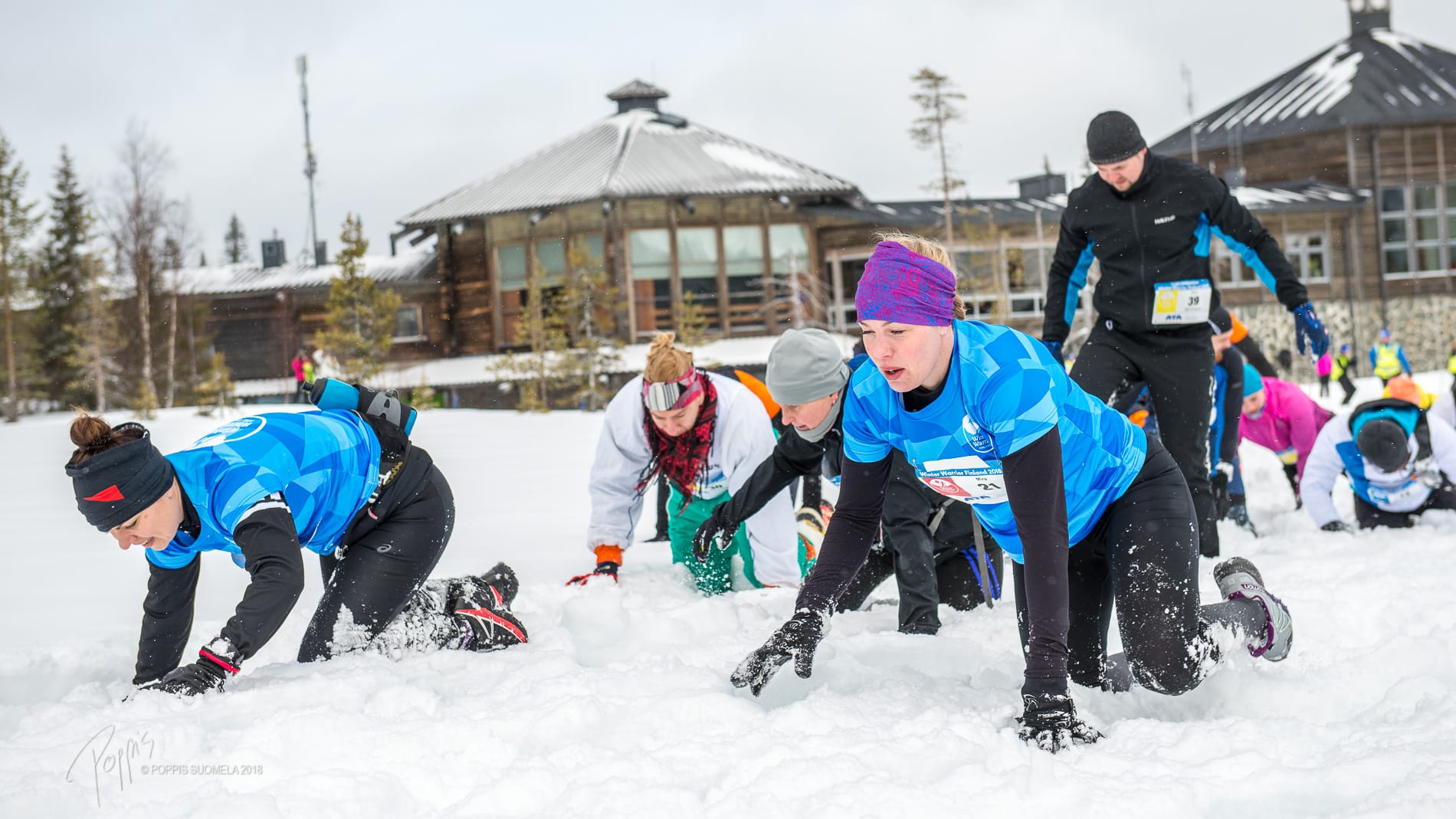
The start sent the competitors directly into deep snow. The only way to move forward was on all fours.
Volunteer spirit and community
In the first year, a core group of volunteers also formed, and most of them stayed involved all the way to the end. For me personally, it was especially meaningful that my son and his partner—now my daughter-in-law—were also part of it. In the later years, they have been an enormous help in bringing the entire event to life. Without Winter Warrior, I would also never have had the chance to get to know my daughter-in-law so well.
In addition to the group formed from family and friends, we gained an important partner in Sieppijärven Sisu. Through them, we found the additional volunteer workforce needed to build the race organization.
A 15-kilometer course with obstacles requires a surprisingly large number of people. In the first year, there were actually more marshals than participants.
Race week was hectic. At times, we almost lost faith, and Simo and I had several arguments. When you are trying to solve dozens of things at the same time and fatigue sets in, even small issues can feel big.
On race day, however, everything fell into place. Both the participants and the volunteers were all smiles, and by the end of the day it was clear to everyone that the race had to be organized again the following year.
One small idea emerged already during the planning phase. Someone suggested creating a list of participants for the obstacle marshals and encouraging them to use participants’ first names along the course.
It turned out to be surprisingly meaningful. Participants were genuinely touched by it, and the warm-hearted volunteers received tremendous positive feedback. At the same time, it became part of the event’s culture.
Over the years, we have received a lot of moving feedback about this. About how a participant is not just a number, but a person—someone who is addressed by name and genuinely encouraged.
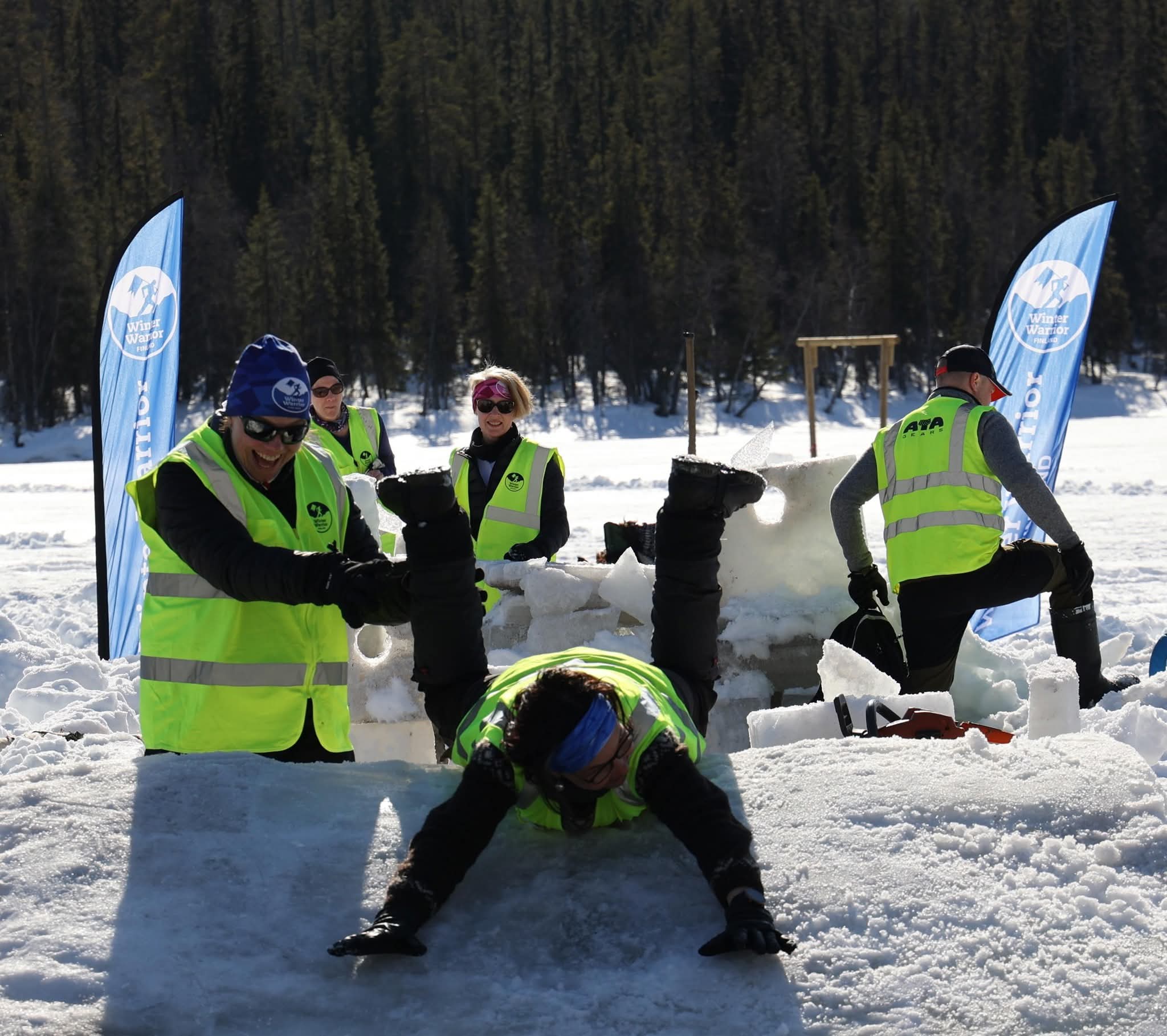
Volunteers goofing around
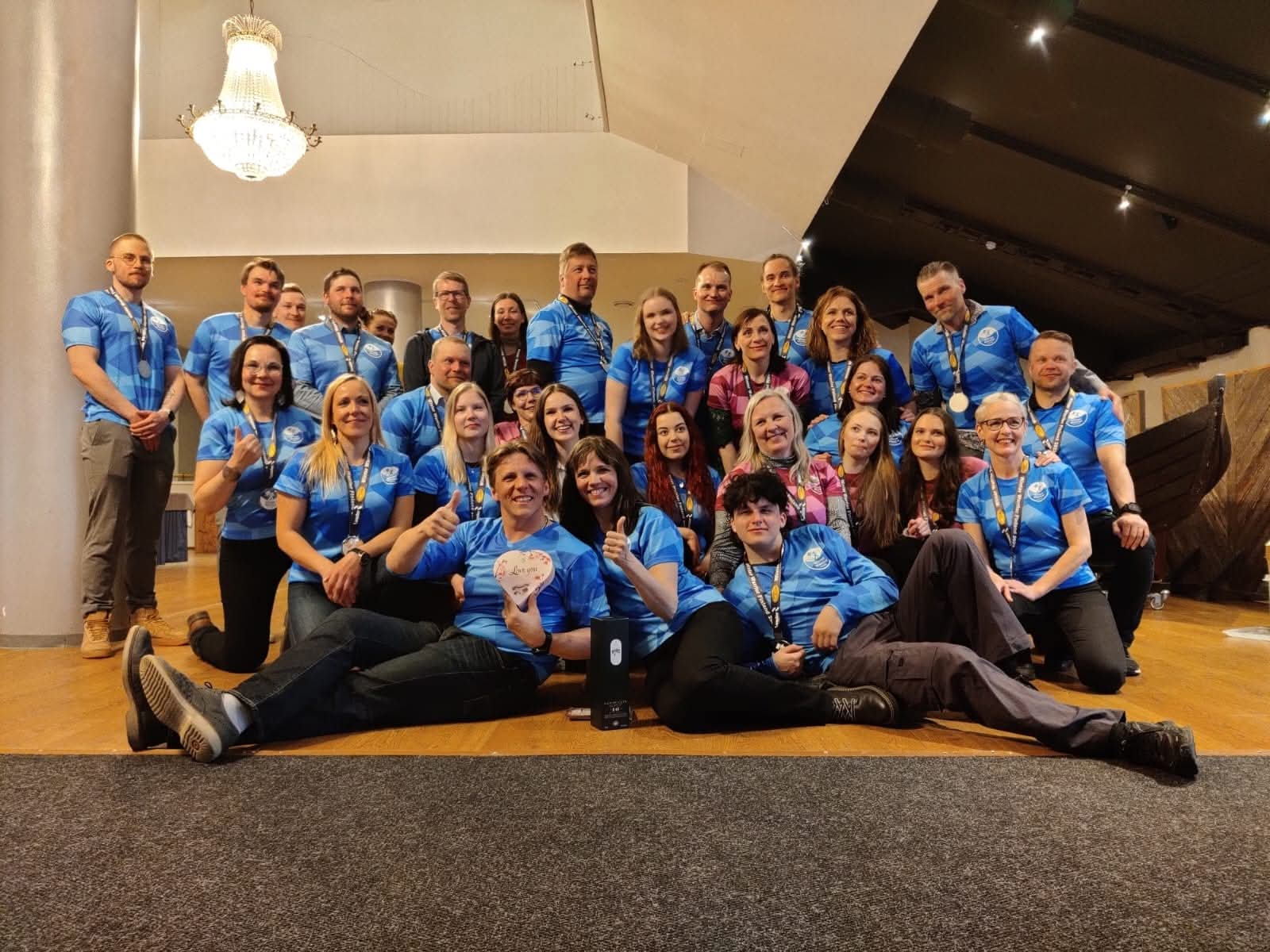
The volunteer crew at Ylläs
Winter Warrior 2019
The following year, there was still a lot of work, but the enthusiasm remained. It was also easier to continue when we already had one successful race behind us.
We went through the feedback received from participants and volunteers and conducted our own “lessons learned” sessions. From the first race, we had accumulated a lot of photos and video material, so we now had something we could actually use to market the race.
The number of participants doubled. That was an important step for us, even though the total number was still quite small. Interestingly, there were still more international participants than Finnish ones.
We had succeeded in positioning the race as very demanding. That attracted international interest, but it also had another side: many people told us they had heard about the race and found the idea great, but considered it too intimidating or too challenging. In addition, the travel costs to Lapland became a barrier for many. Even for Finns, the trip often felt like a surprisingly big decision.
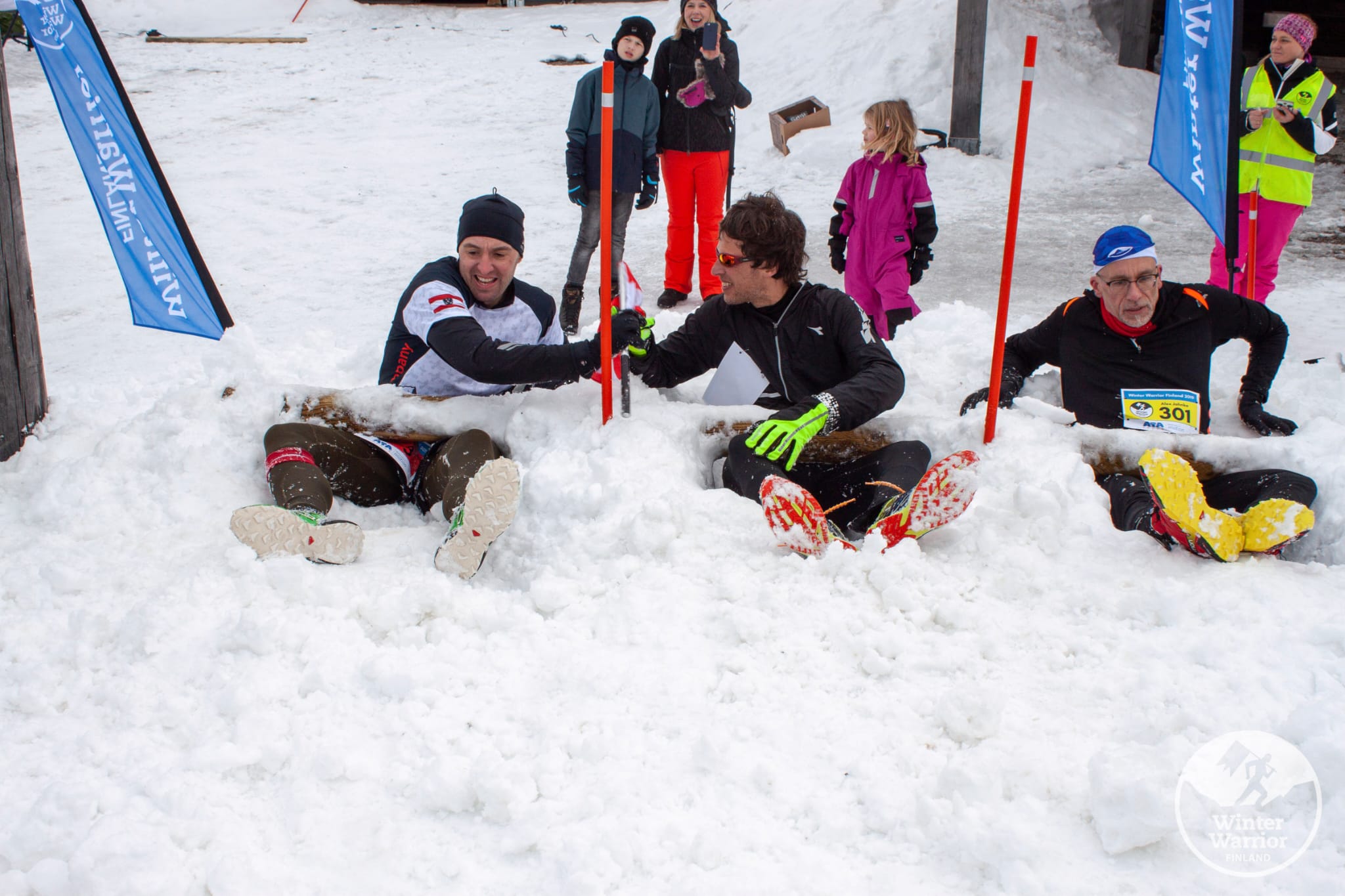
The final obstacle of the race was to dig your way under a log lying in the snow. The obstacle was simple, but it challenged both mentally and physically. The competitor could already see the finish straight ahead, but digging with the last of their strength turned out to be surprisingly exhausting, and technique ultimately played a major role in how fast the task could be completed.
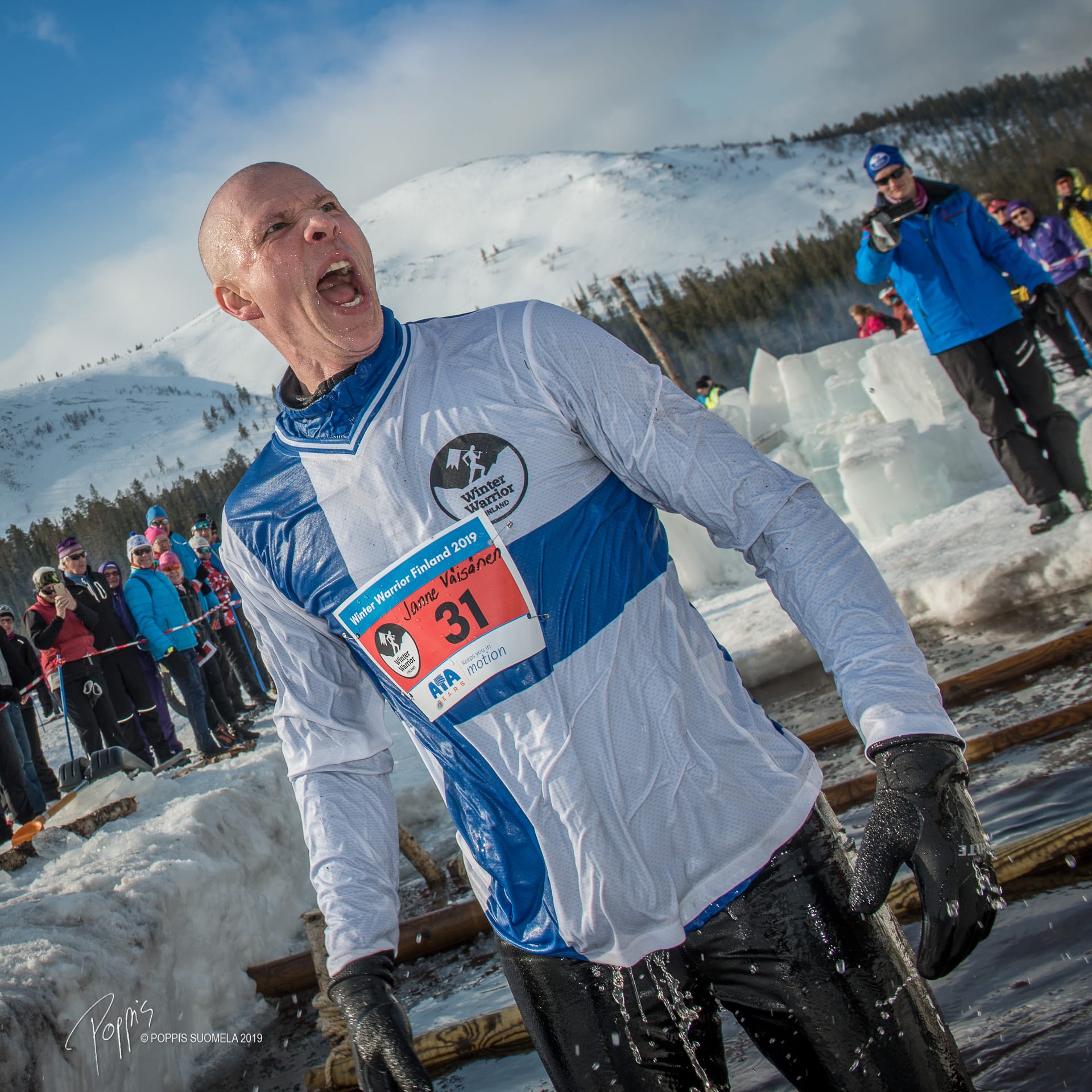
The feeling after completing the ice swimming obstacle I Scream Tunnel is undefeated
The third year—and the world comes to a halt
The much-talked-about third year was ahead. As we had already learned early on, the third time would show whether the event would truly take off.
Registration got off to a strong start, and it looked like the number of participants would double again. We also received our first promise of actual financial sponsorship. A local entrepreneur had been following our progress and said they had heard great feedback about the event from others. That felt like a significant step, because while operating in Lapland, we had noticed that organizers from the south were sometimes viewed with a bit of suspicion.
This was the year 2020. At the beginning of the year, increasingly concerning news started to emerge about a new virus, but for a long time, it still seemed that it would not affect the race. Preparations continued as normal, registrations were higher than ever, and everything appeared to be in good shape.
As race week approached, everything was practically ready. We were already in Lapland ourselves, finalizing the arrangements. Then the situation changed very quickly. Suddenly, restrictions began to tighten, events were being canceled around the world, and eventually, decisions were made in Finland as well that brought everything to a standstill.
Just one week before the race, it became clear that the event could not be held. It was a difficult moment for us. Months of work were behind us, and everything was already prepared. Still, there were no alternatives. The race had to be canceled.
We wanted to do something to ease the disappointment of the participants, so we came up with the idea of a virtual race. We asked participants to film challenges they devised themselves and send the material to us so that we could compile a shared video.
The videos were creative, funny, and at times, deeply moving. One participant had built an obstacle course in their living room; another carried a log through a snowy forest. People clearly wanted to be part of the event, even though the race itself could not take place. The compilation received unexpectedly wide attention—the video was even shown as a light closing segment on the evening news.
Meanwhile, Simo and I sat together in Lapland in the volunteers’ cabin, watching the videos and wandering through the forests, trying to make sense of the world. Participants were informed that the event would be moved to the following year and that their registrations would be automatically transferred.
For us, the situation was difficult. We did not receive sponsor income, and we no longer had the possibility to invest more of our own money into the event. Government support related to COVID did not apply to a small-scale operation like ours. The whole world was in turmoil anyway, and the year felt strange in every way.
The race had already been announced for 2021, so we turned our focus to that. In 2021, the race was canceled again at the very last moment due to a restriction limiting gatherings to 50 people. It felt absurd on a 15-kilometer course in a national park. We had carried over the registrations, and we would not have been able to refund them. Still, it was a matter of honor for us to keep our promise.
The race would finally take place in 2022.
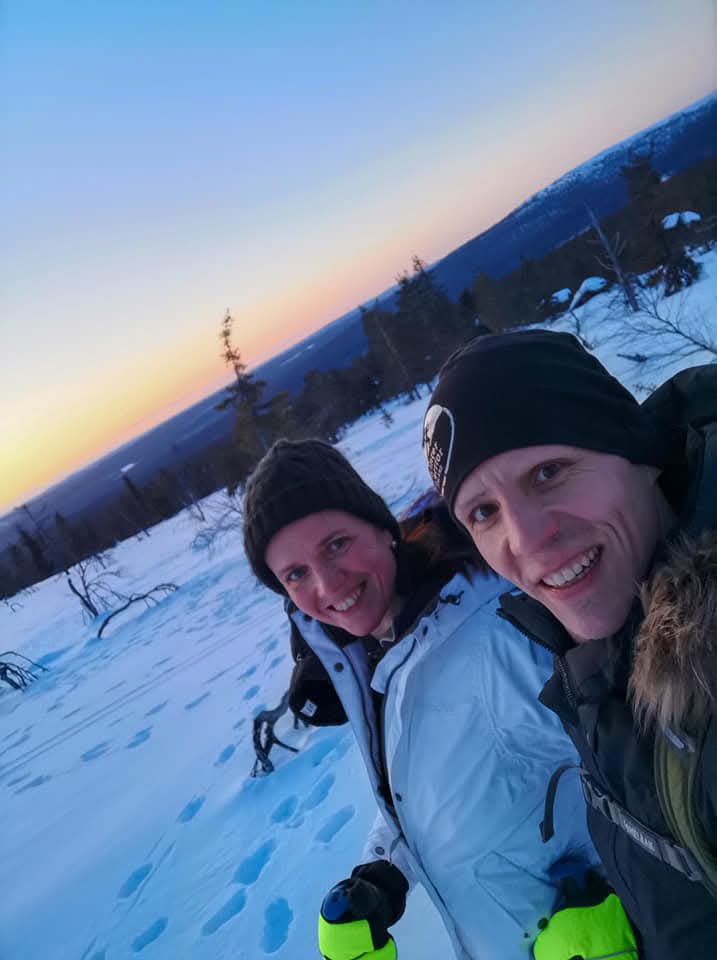
Just the two of us in Lapland during race week on the first COVID year.
Return to normal
In 2022, the world finally began to recover from the pandemic, and the race was able to take place. We had thought it would be the last time. It started to feel like we no longer really had the energy to continue.
But race week and race day were once again just as great as before. The atmosphere was excellent, and both participants and volunteers were in good spirits. For us as well, race week has always been the highlight of the year—a moment to step away from everyday life and focus entirely on the race and the people around it. There is something special about building something together. And the expressions on participants’ faces at the finish make all the work worthwhile.
At some point, however, rumors began to circulate that the race might be ending. We had not wanted to market the event as the last one, even though the thought had crossed our minds. We had seen another event operate that way—marketing it as the final year and then continuing afterward. Many found that misleading, and we did not want to follow that path.
In the end, it turned out as it often does: the enthusiasm of the participants and the volunteer team made us change our minds. We had now finally managed to organize the race that had been postponed twice due to COVID. We thought that we could try once more to organize the event under normal conditions.
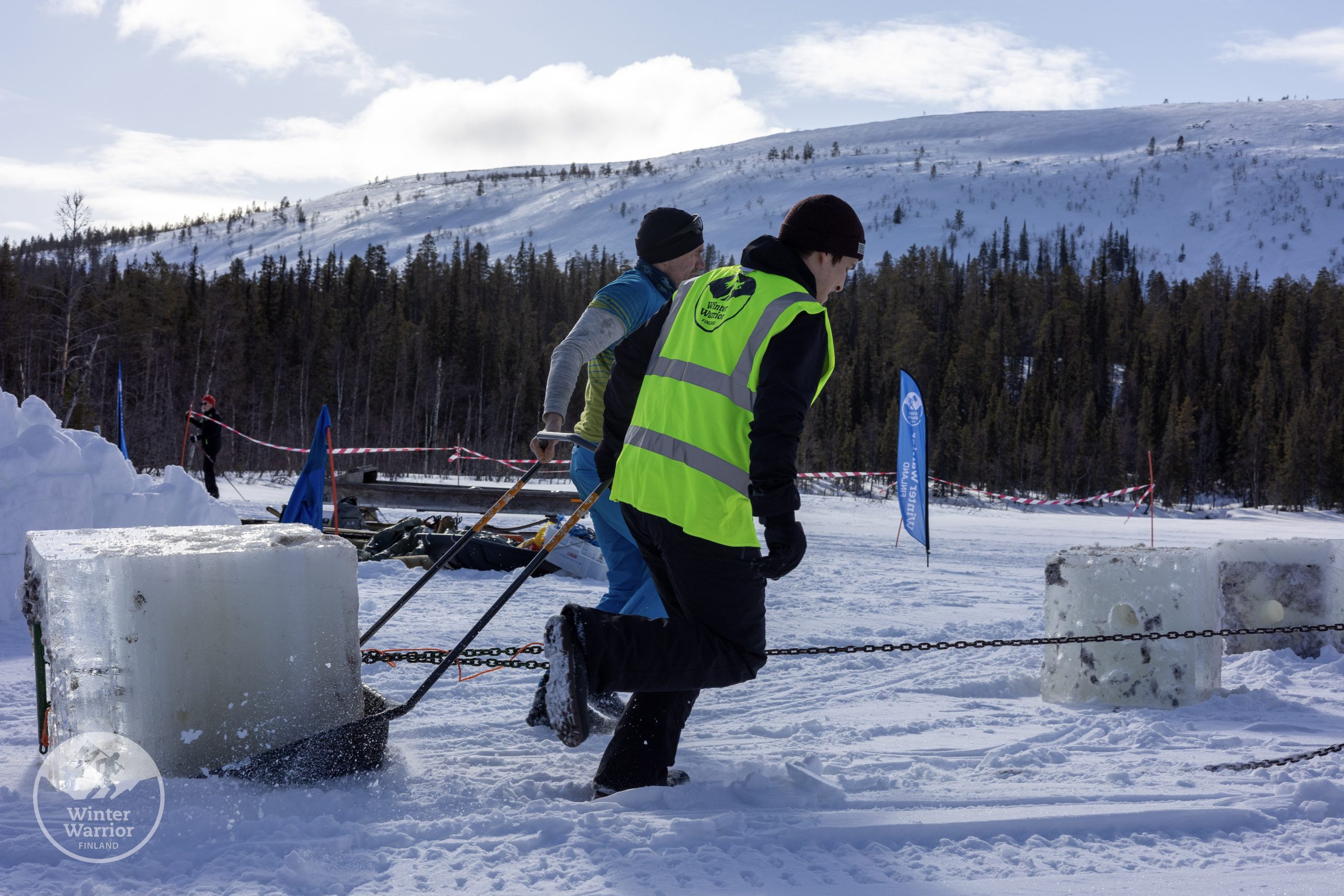
Building the I Scream Tunnel is quite an undertaking. Dozens of massive ice blocks are cut from ice nearly a meter thick. Lifting the blocks out of the water is the most challenging part.
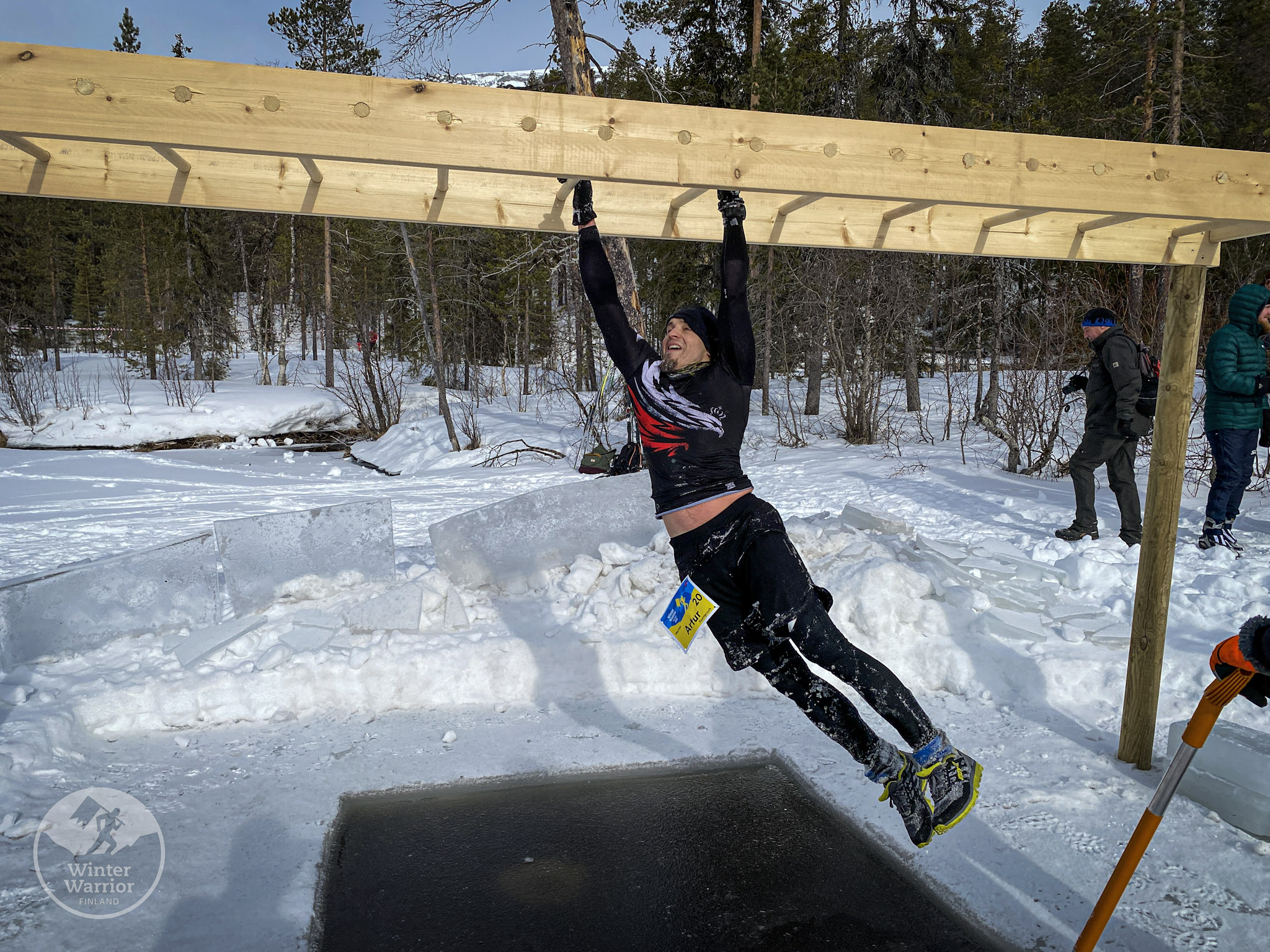
A demonstration of technique on the Monkey Bar obstacle. You don’t want your grip to slip if you want to stay dry.
Moments along the way
Over the years, many small moments have stayed with us. The kind that may not be visible from the outside, but that speak volumes about what organizing an event is really like.
One particularly memorable and moving moment from Ylläs has remained especially vivid in my mind. I do not remember exactly which year it was.
On the evening before race day, around half past nine, Simo and I were sitting at the race center, staring somewhat desperately at the start and finish area, which was still completely unmarked. The day had been long and exhausting, and most of the volunteer team had already left to enjoy a well-earned sauna after the day’s work.
We just sat there in silence for a moment, wondering how we would get through it.
Then suddenly, a small procession appeared. My son’s friend Veeti walked in at the front, followed by a few others who had come to help. The start and finish area was quickly marked, and suddenly everything was ready.
We were finally able to go to sleep.
It was a small moment, but these years have been full of moments like that—people showing up to help exactly when it is needed most.
From the first year, what remains in my memory is the race week, which was so hectic that what I mostly have left are just vague impressions. The days were long, and so much was happening all the time that there was hardly any chance to properly process it all.
One moment, however, I remember clearly.
Race day was over, and the volunteer team was heading to the sauna. I was completely exhausted, but one thing still needed to be done: a post about the results. At that moment, it felt overwhelming. I sat there tired and quite discouraged.
Then my son Jesse noticed the situation. He sat down next to me and said calmly:
“Let’s do it together, Mom.”
And so we did.
The final year in Ylläs
After the COVID crisis, we had finally managed to organize the postponed race. The following year was supposed to be normal again: a year when participation fees would once again cover costs and the event could return to its regular rhythm. We knew well that getting participants moving again would take time. Still, we were ready to try once more.
Then something happened that changed everything. The national park permit officer changed just before the 2023 race. The new officer was the same person who had already been critical of the event in its early stages.
The 2023 race was still allowed to take place, as it had already been agreed upon. At the same time, however, we were informed that a permit would no longer be granted for the following year, and the race would have to be moved outside the national park area.
For us, that was essentially the final nail in the coffin.
That specific route—Kesänkijärvi and the surrounding fells—had originally been what inspired us to start the entire project. The idea of rebuilding everything from a completely different foundation felt impossible at that point. We had already been questioning whether we had the strength to continue.
So, during the 2023 race, we told participants that this would be the last Winter Warrior in Ylläs. We also published a compilation video on social media from the Ylläs years.
After the race, we were still asked whether we could continue. But that was no longer an option. Many may not have fully realized how much work organizing the event had required.
In 2023, the final Winter Warrior in Ylläs was held.
From the years in Ylläs, we are left with many wonderful memories and deep gratitude for all the people who were part of the journey.
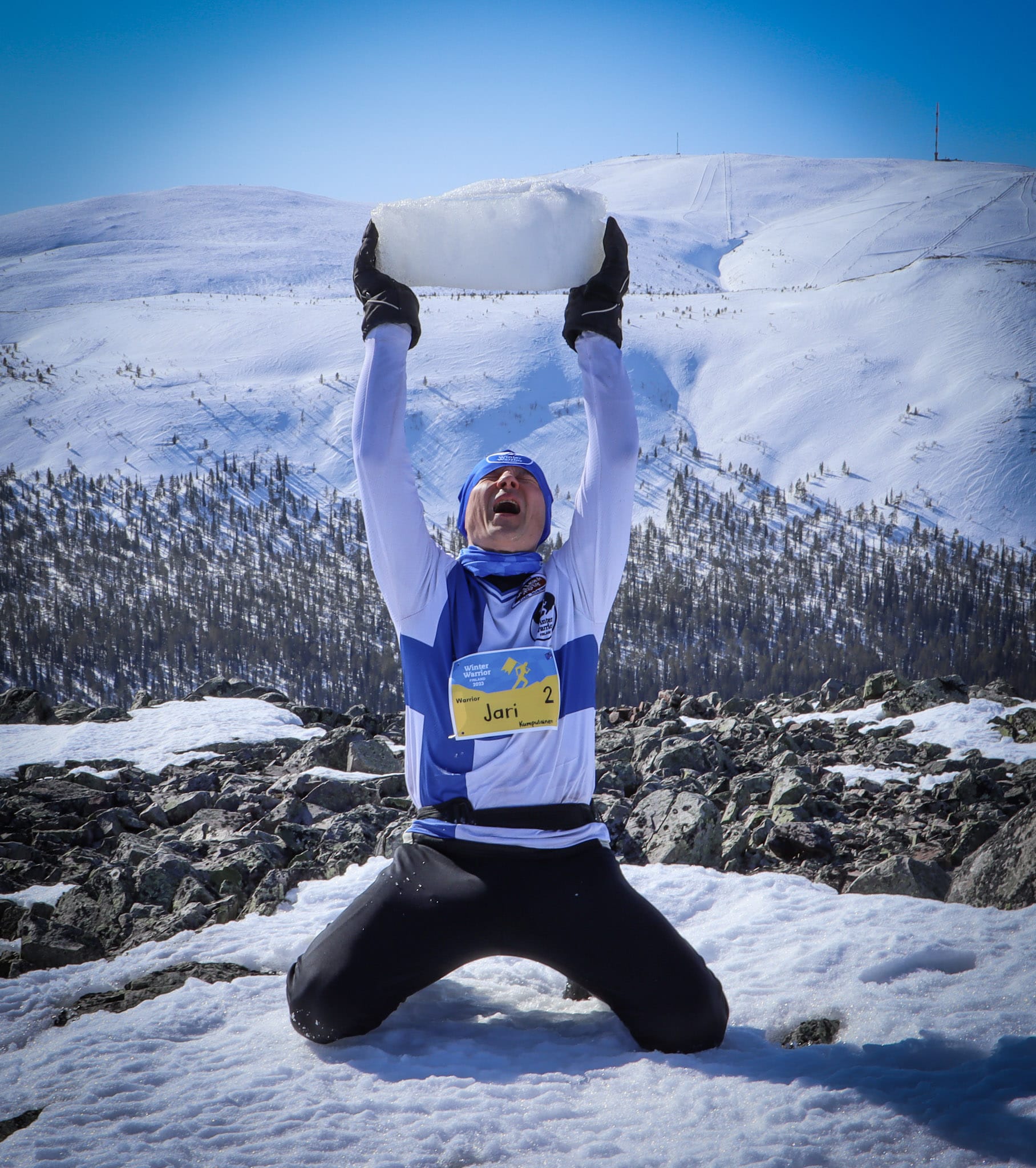
The feeling at the top of the fell is incredible as well. Especially when you’ve carried a massive chunk of ice all the way up from below.
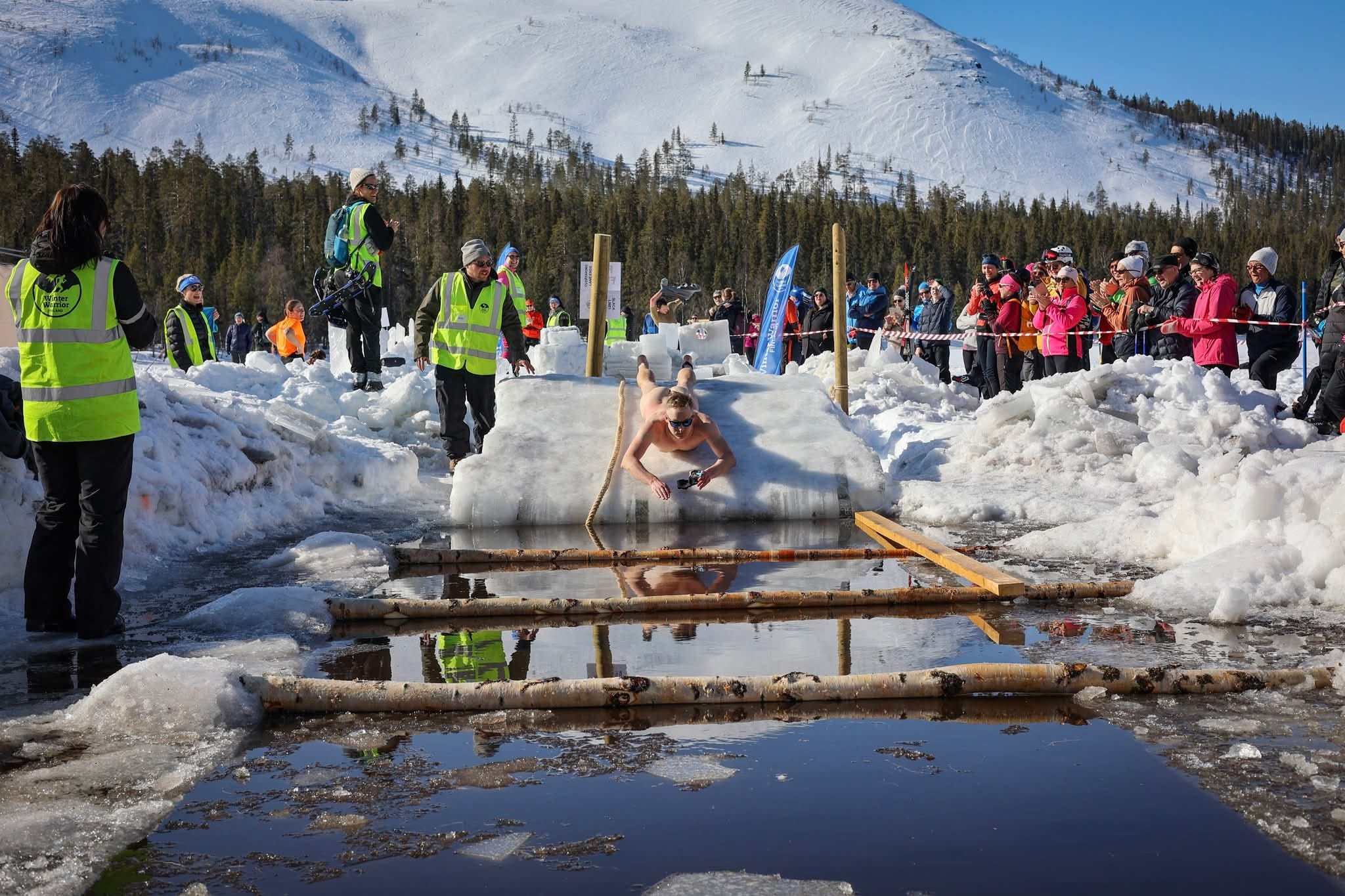
You can also enter the ice hole in style.
The idea of Tampere and a social media pause
Even before the COVID years, we had considered the possibility of organizing the race not only in Ylläs but also in Tampere. Tampere is our home city, and it would also be possible to create a winter obstacle race there in beautiful surroundings, even if it would not have the same kind of Lapland exoticism.
The idea had been quietly growing in the background. At some point, however, it started to feel like this was a card we had to play.
We thought that an event in Tampere could be more approachable. Traveling would be simpler for many, and the barrier to participate would be lower for those who might not be looking for quite as extreme a challenge as in the fells of Lapland.
After the final race in Ylläs, we published the race video. After that, we decided to go silent on social media. In the end, that silence lasted ten months.
One thing that had become very clear over the years is how much work continuous presence on social media requires. For an event like this, social media is practically the only way to reach enthusiasts and people interested in the sport around the world.
But visibility does not happen on its own. Content needs to be produced continuously, and each post needs something engaging. Over the years, the nature of social media also changed. In the early years, posts were more readily commented on and shared, but later it clearly became more difficult to reach audiences.
That is why the ten-month break felt genuinely liberating. For a while, we did not have to think about the race, posts, or algorithms.
The groundwork begins
After the final race in Ylläs, we almost immediately began exploring whether Winter Warrior could be organized in Tampere.
The idea was not entirely new. As early as 2019, we had discussions with representatives of the City of Tampere and had formed the impression that this kind of winter outdoor event would be a very welcome addition to the city’s event calendar. However, COVID disrupted those plans.
Now we got back in touch and started the groundwork again from the beginning.
By that point, we had blissfully forgotten how much work launching a new event actually requires. So once again, we found ourselves starting from scratch, one step at a time.
The first questions were very similar to those years earlier when we planned the first race in Ylläs.
Where in the city could the race be organized?
Where would there be enough space for a versatile obstacle course?
Where could an ice hole obstacle be built?
Where could permits be obtained—and how are they even applied for?
In Ylläs, we had the fells and the national park. In Tampere, we had a city.
That meant an entirely new kind of system to learn.
Figuring out permits turned out to be surprisingly difficult. Contact persons changed, and no one seemed to know exactly what permits would be required for an event like this, or whether it would even be possible. It was a new learning experience for us. In an urban environment, organizing an event inevitably involves more complex bureaucracy than in the fells and forests.
It quickly became clear that at least one gap year would be necessary.
In addition to the race route, there is one absolutely essential element in organizing an event: the race center. A place is needed with sufficient facilities, space for the start and finish, and the ability to bring participants and spectators together. It is also important that the ice hole obstacle is located relatively close by, so that the distance to the finish is not too long afterward.
Fortunately, Särkänniemi responded positively to our approach. At first, there was some hesitation, which is entirely understandable with a new type of event. As discussions progressed, however, they became an excellent partner.
Deciding the date of the race turned out to be its own particular challenge. From the beginning, the race centered around the ice hole and running on ice. This is not only interesting and exotic for international participants, but also important for the flow of the course. Ice enables route solutions that would not be possible on land.
However, winters in southern Finland are unpredictable. So we had to carefully determine when the risk of unsafe ice conditions would be lowest. At the same time, other factors had to be considered. There needed to be enough daylight for the race to be held safely. On the other hand, the date should not fall in a period when severe cold would be most likely.
Choosing the date for a winter race turned out to be a surprisingly complex puzzle, but we eventually settled on late February, and step by step, things began to move forward.
Planning begins in Tampere
Once the decision was made, practical planning became relevant again.
Planning the Tampere race briefly brought back the same excitement we had felt in the early years in Ylläs. During the gap year, there was once again time to be outdoors and explore potential routes. Simo and I took several long walks and enjoyed rediscovering our home city.
I, at least, fell in love with Tampere all over again. Especially when viewed from the ice of Näsijärvi, the city looks stunning. Ranta-Tampella and the Santalahti event park connect the lakeshore to the city center in a way that makes the whole area feel surprisingly cohesive. And everything is within walking distance.
In Pispala, we also discovered entirely new paths. As an interesting detail, the city’s street engineer tipped us off about small tunnels running under the railway, which turned out to be quite useful from a route planning perspective.
One of the most interesting places, however, was the Uittotunneli. It is normally closed, but we were given the opportunity to visit it. The tunnel runs beneath the Pispala ridge and provides a quick connection from the shores of Näsijärvi to the Pyhäjärvi side. It was an intriguing experience—and at the same time a reminder of how many unexpected places a city holds when you start exploring it from a slightly different perspective.
We still had the core group that had formed over the years, around twenty people who had been involved for a long time. Almost all of them were still enthusiastically on board, which was extremely important to us—and in fact a prerequisite for us to even consider organizing the race in a new location.
In Tampere, however, a new kind of challenge quickly emerged. We soon realized that around one hundred people would be needed on race day to organize the event safely and smoothly. The budget was by no means sufficient to use paid services, so everything had to be done on a volunteer basis. We found the additional help needed through our circle of friends and the city’s volunteer pool.
In the end, we managed to assemble a sufficiently large volunteer team. However, organizing and briefing such a large group is a considerable effort. It is not easy even when everything is well planned—let alone when the organizers themselves are still learning as they go. We did not yet know exactly how everything would work in practice or what would ultimately be possible. In a large volunteer group, there are naturally many different expectations. Every year, we have conducted feedback surveys for both participants and volunteers, as our aim has been to continuously improve the event.
Perhaps it has even been a bit too important for us that everyone would have a good experience. In reality, however, it is impossible to please everyone. Feedback inevitably includes conflicting views—for example, regarding communication, some felt there was too little, while others spoke of information overload. It reflects well how different expectations people can have.
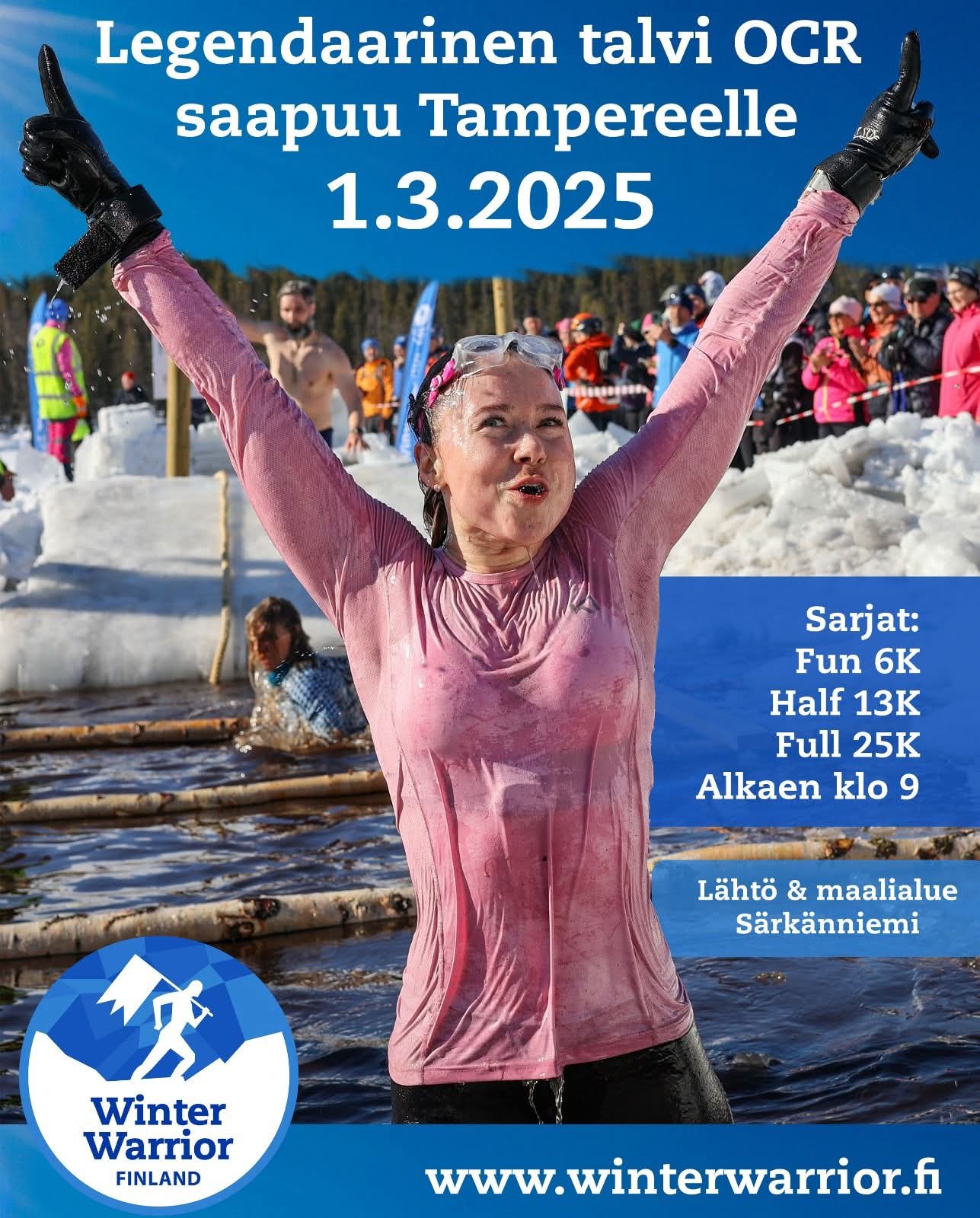
The poster for the Tampere race
The route master’s challenges
Designing the race route and obstacles is a discipline of its own. In Winter Warrior, this has mainly been Simo’s responsibility as the route master, although ideas are of course developed together. Versatile and appropriately challenging obstacles are, in fact, the most important element in an OCR race. The race should be demanding enough even for the strongest athletes, but at the same time such that every participant has a chance to overcome their limits and reach the finish line.
However, the course and obstacles must be implemented within a very short time. Everything is built and marked within a few days before the race and dismantled within 24 hours after the event. This requires constant planning and cooperation. Partners are needed to help build obstacles or provide the necessary equipment. In addition, permits are required for what can be done and where.
There is a constant chicken-and-egg situation. For permits, you need to be able to describe in detail well in advance what you plan to do. But working out those details requires a great deal of effort, testing, and planning.
In a winter race, you must also be prepared for conditions to change quickly. This risk materialized already in the first year in Tampere. The winter was unusual, and ice conditions were weak. Still, even two weeks before the race, everything looked good.
In a winter race, one important safety issue relates to footwear. We had always prohibited spiked shoes, because in crowded obstacles participants can easily kick or step on each other while climbing or crawling. Then the weather suddenly changed. The streets became dangerously slippery, and we had to make the decision to allow spiked shoes. At the same time, this meant changes to some of the obstacles as well.
The real curveball came during race week. Rising temperatures raised doubts about whether the ice would hold. For several nights, we barely slept, as alongside everything else Simo went out to measure ice thickness and we kept considering what to do.
In the end, just two days before the race, we had to conclude that the route would need to be changed radically. The planned crossing of open Näsijärvi would not have been safe.
We had originally considered alternative routes, but since the situation had still looked good a couple of weeks before the race, we had not used our limited resources to develop multiple detailed alternatives and apply for permits for them. Even planning a single route was demanding, and in Tampere additional challenges came from construction sites and the constraints of the urban environment.
In addition, most of the volunteer team arrived only on race day. They had to be briefed on their roles and the route on site. That made last-minute changes a significant communication challenge.
The unavoidable last-minute route changes led to one major problem. The route was not marked clearly enough. Some participants were not able to follow it as intended in all sections, which understandably caused frustration. For us as organizers, it was a difficult moment. We had done our best in a challenging situation, but we also knew that route marking is one of those things that should work flawlessly.
Despite everything, the race as a whole was successful, and the feedback—despite the confusion—was very positive.
In Ylläs, we never published the exact route or obstacles in advance. The route took its final form during race week, and conditions had a significant influence on it. In the fell environment, that kind of flexibility was possible.
In a city, however, the situation is different. The route cannot be changed in the same way at the last minute, and due to permits and safety, plans need to be much more precisely defined in advance. In addition, with a large volunteer team, it is important that routes and obstacles are clearly described well ahead of time.
Participant feedback reflected a familiar contradiction. Many would have preferred to know the exact route well in advance of the race. At the same time, others questioned why we had not been better prepared for last-minute changes.
In a winter race, however, these two requirements are often in conflict. The more precisely the route is fixed in advance, the harder it is to react quickly to changing conditions. It is one of the many balancing acts involved in organizing an event like this.
One small detail still comes to mind—perhaps a slightly amusing example of the kinds of things you have to be prepared for. The Full Warrior course partly runs through the forest area of Kauppi. On the morning of race day, however, the marshals in that area were wondering where the route actually went. During the night, someone had removed the course markings.
Fortunately, the team leader for that area was an experienced veteran. He quickly brought the situation under control and restored the markings. During the morning, the same person apparently tried once more to remove them, so for a brief moment there was a small race of its own taking place in the forest.
Situations like these are part of event organizing—things happen that you simply cannot prepare for in advance.
The race is over
The first race held in Tampere was finally over.
The main feeling was one of immense relief. After long preparations, last-minute changes, and many uncertainties, everything had ultimately gone well.
The most important thing was that the race was completed safely. In an event like this, that is always the organizers’ biggest concern. This year as well, we avoided accidents—both among participants and volunteers.
Except that… after the race, while dismantling the final obstacle, Simo slipped on the ice and badly fractured his finger. But that is a story of its own.
The award ceremony held on the evening of race day was warm and heartfelt. One particularly moving moment stands out, when participants who had traveled from Poland took the floor. They thanked us for the event and said they understood well how much work organizing a race like this requires.
At least for me, it was clear that this could not be a one-time effort.
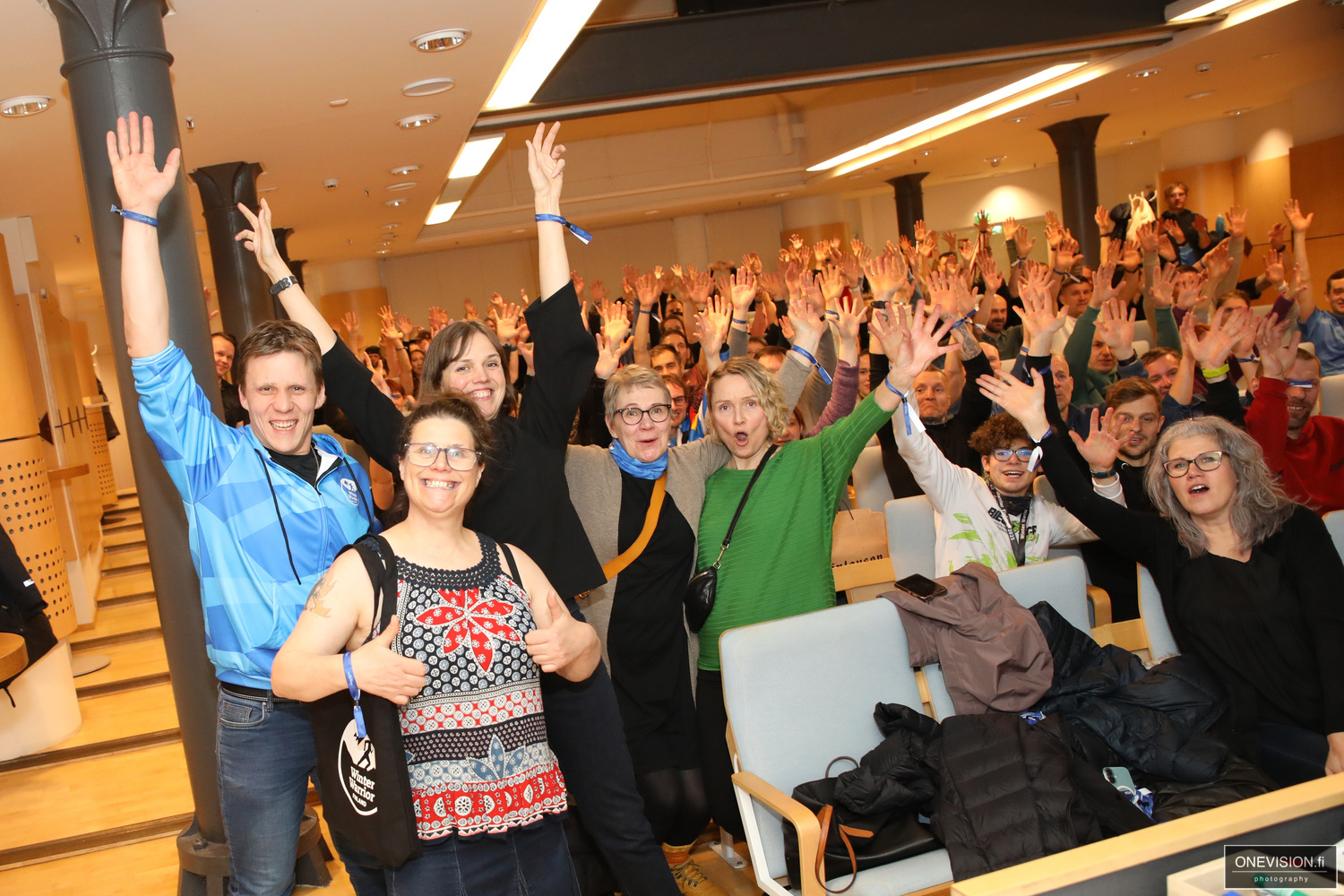
The award ceremony after the first Tampere race
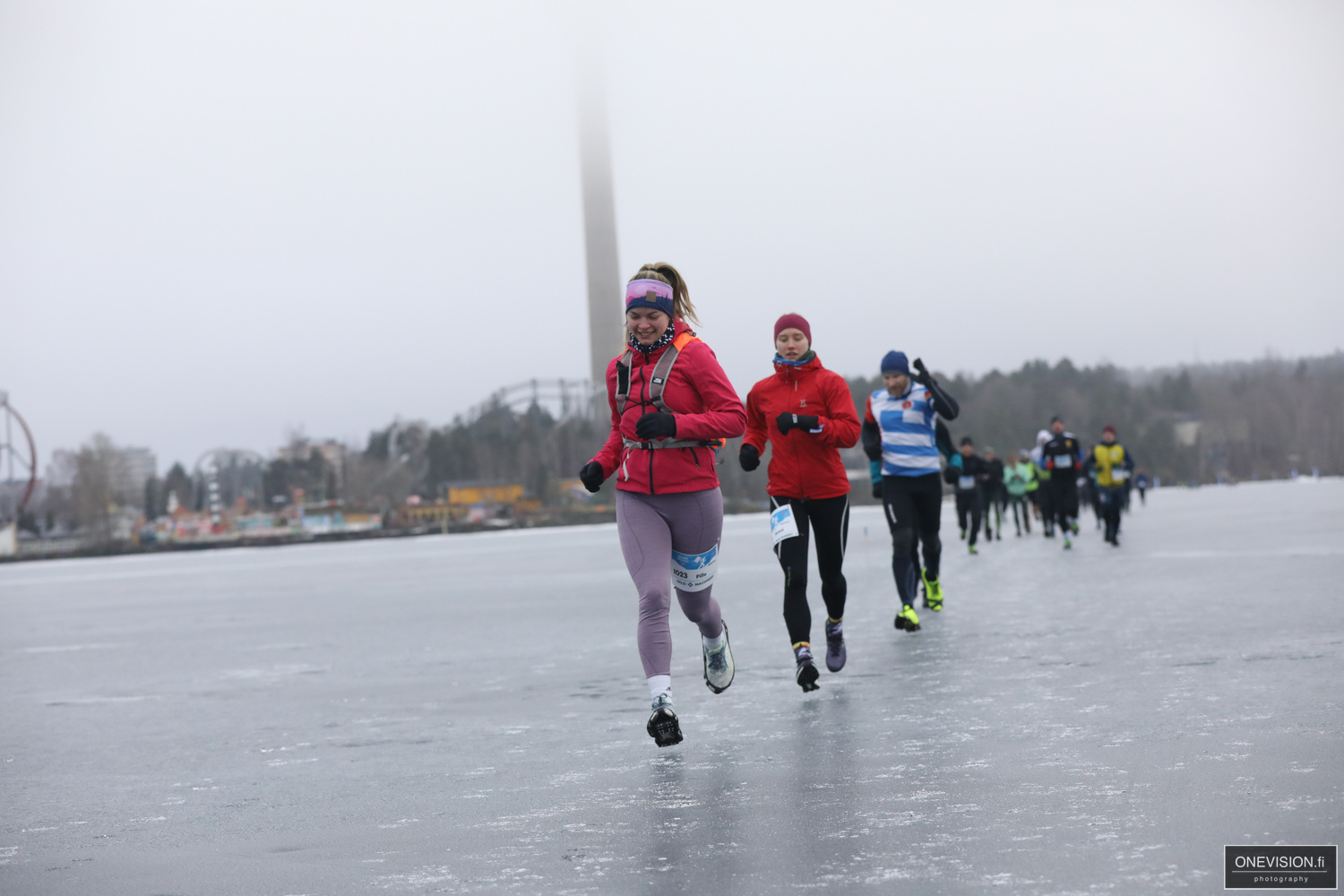
Running on lake Näsijärvi
Financial realities
Although money has never been our motivation, it is an unavoidable reality. If the event is to continue year after year, it needs to be financially sustainable in some way. The economics of a race like this are challenging, because the workload is large relative to the number of participants. Building the course, obstacles, safety arrangements, officials, and the entire event logistics all translate into a massive number of working hours.
Making a living from an event like this would not be possible without a very large-scale operation—such as Spartan Race. However, the event could become financially viable if the number of participants grew to several hundred or even one to two thousand.
In Tampere, that could be possible.
In Finland, obstacle course races have proven capable of attracting large numbers of participants. The Tough Viking race held in Helsinki once had as many as five thousand participants, and the first Spartan Race Lahti in Lahti attracted over three thousand. However, those are summer races, when the threshold to participate is significantly lower.
A winter race, on the other hand, is something different. It is unique, and for many, that is exactly what makes it interesting. Its appeal is also reflected in the fact that participants in the Tampere race came from nearly twenty different countries, even though we had initially wondered whether southern Finland would feel exotic enough compared to Lapland.
Although no formal promises had been made, we had formed the impression that the City of Tampere might support the event in some way—if not directly financially, then for example through marketing. We had understood that a winter outdoor event was something the city wanted more of.
The reality turned out to be somewhat different.
With the first Tampere race, we tried to explore possibilities for obtaining some form of support for the event. We had in mind the advice we had heard in Ylläs: the third year reveals the true potential of an event. We therefore already knew that growing the event into something financially viable would take time. We would need support in the early stages for the race to grow.
Securing sponsors is also easier when an event is already large and visible. For a new event, it is difficult to promise the kind of visibility that sponsors naturally expect.
We tried to find out what kinds of support might be available for an event like this and through which channels to apply. It turned out to be surprisingly difficult even to determine what options existed. There did not seem to be a support mechanism directly suited to this kind of activity, and it was not clear who to ask or what exactly to ask about.
Eventually, shortly before the race, we were asked to fill out a so-called major event application so that the matter could be processed through that channel. It felt somewhat odd, as we were by no means organizing a major event. Still, in the middle of everything, we completed the extensive application. Only after the event did we hear that there had not been time to process it, and that for the following year it should be submitted early enough.
So we began early to explore funding possibilities for the second year. Once again, we were asked to submit an application intended for major events. We were told that we had been decided to be handled in that category. After that, however, we received no response to our messages for a long time. Only shortly before the race, when we followed up again, did we finally receive an answer. This time the message was that there was currently no suitable form of support available for us—perhaps next year.
At that point, the decision began to become clear: the 2026 race would be the last, at least in this form. We decided to focus on making it the best possible experience for everyone—participants, volunteers, partners, and also for ourselves. The idea was to end this chapter on a positive note and leave behind good memories.
Winter Warrior Finland 2026
After the first race, we contacted all our partners and reviewed the experiences from the first year. The most important thing was that there was no real negative feedback from any direction. Even from the city’s side, there was no need seen for a separate feedback discussion. That gave us a strong signal that there was space for the event and that it could continue.
We also knew that the second year would be easier in many ways. The basic structure was now in place: the route, the race center, partners, and practical arrangements. With the same setup, the event could be carried out with significantly less work than the first time. We already had experience of how the event works in practice. In addition, we had team leads who had been involved from the first year and understood what it was about. We were able to give them real responsibility for different areas, which significantly reduced our own workload.
In the second year, we also decided to adjust the volunteer onboarding. We offered clearly defined options for participation and tried to make the overall setup more flexible.
We also now had established partners with whom collaboration worked smoothly. When people know each other and understand how the event operates, many things become much easier.
It also made the whole process more enjoyable. We had a better sense of where the pitfalls were and were able to prepare for them differently.
When registration opened, it was immediately visible. In the first few days, registrations were about 50 percent higher than at the same time the previous year. It felt like a good sign. The event was clearly starting to find its audience.
However, we did not quite succeed in communicating the more accessible Fun series. Although it was intended as a lower-threshold option, it did not reach participants as hoped, and the overall number of participants remained slightly too low.
This year also brought some unfortunate timing with other events. Several events fell on the same day, and in particular the large UMK event seemed to affect the availability of volunteers. It is also possible that it drew away some potential participants, especially from the Fun series.
Nature once again decided to add its own complications. Just before the race, there was a wave of illness that took out a large number of volunteers at the last moment. At the same time, the weather did its part. The winter had otherwise been excellent. An unusually long cold period had made the ice very thick, so there was no concern about its strength.
But at the very last moment, the forecast changed. Temperatures rose quickly, and within a couple of days the snow melted, making conditions dangerously slippery once again. On the lake, there was at worst water up to knee level on the ice. Canceling the race was not even considered. Instead, we made some adjustments to the route and obstacles. A couple of obstacles were removed entirely, as they had become too dangerous due to the conditions.
The conditions were immediately visible at the start. To reach the start line on the lake ice, participants had to wade through water, so their shoes were already soaked before the race had even begun.
Fortunately, this is Winter Warrior Finland—and harsh conditions are, in a way, part of the spirit of the race.
This time there were some withdrawals due to cold and fatigue, but overall the experience was memorable for many. In a race like this, one thing often holds true: the tougher the course and the harsher the conditions, the sweeter it feels to reach the finish—and the stronger the memories become afterward.
We had already decided that this would be the final race.
The decisive factor had been that the city did not provide financial support. Without that, continuing the event no longer felt realistic. So we decided to focus on making the final race the best possible experience for everyone.
We wanted race day to leave a great memory for participants, volunteers, and partners alike—and perhaps this time also for ourselves, so that we would have a moment to be outside and truly take in the atmosphere of the event.
I trusted that everything at the race center would run smoothly in the hands of the experienced volunteers, and this time I was able to spend more time on site following the event. I was there to watch every start and, in the end, to send off two brave participants who, after finishing their own race, still had the energy to head out for the Double Warrior lap. Simo went with them.
I walked along in hiking boots. They kept my socks dry almost until the end.
A day to remember.
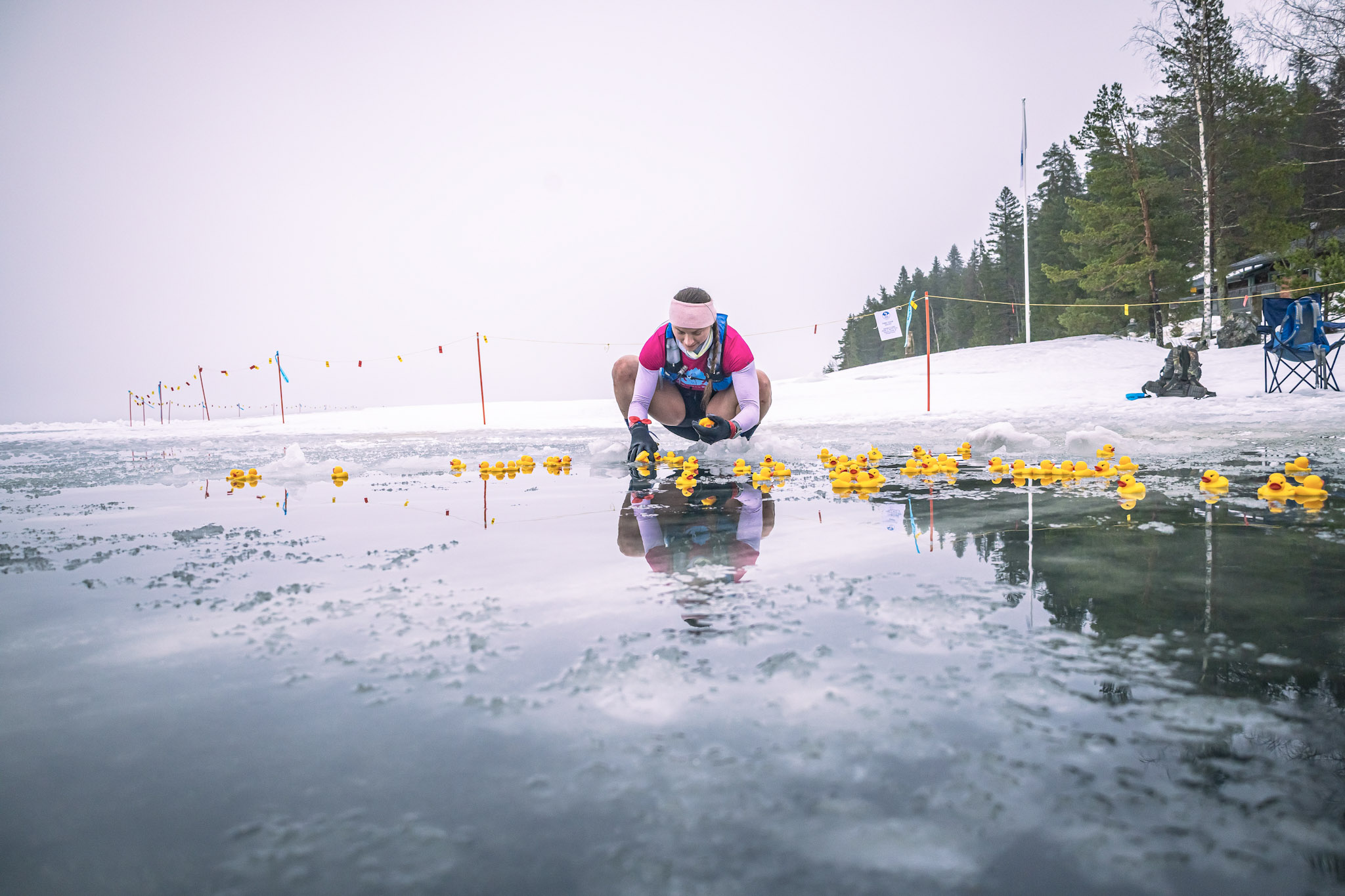
Finding your own rubber duck
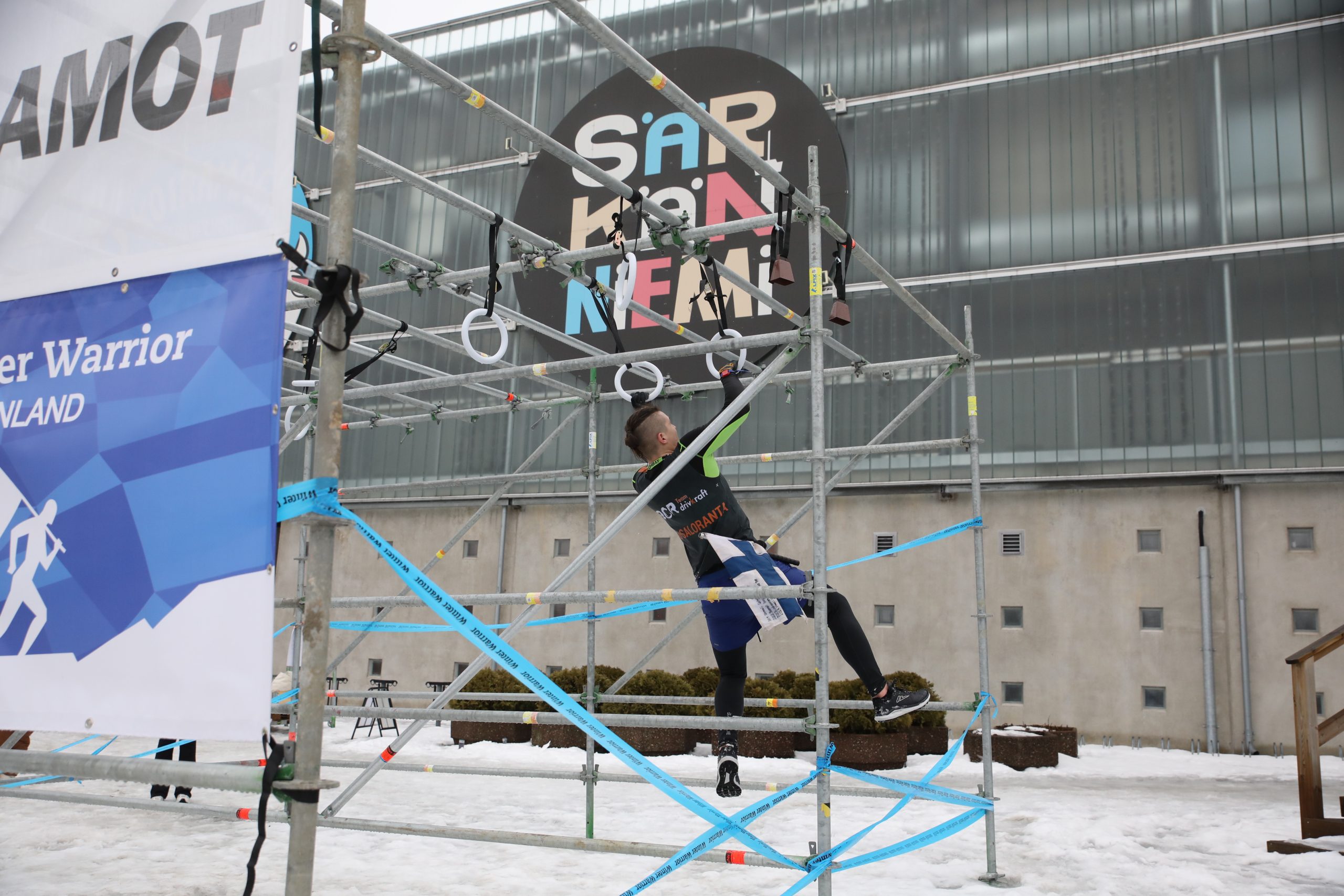
A display of skill from the 2026 race winner, Joni Saloranta, on the final climbing obstacle just before the finish.
Our dynamic and division of roles
Our roles in this project were very different from the beginning.
Simo is the visible front figure of the race—the one who runs the course himself with his face painted, carrying the Finnish flag, and enjoying pushing himself and others to the limit. I have only participated in a winter OCR race once—in a lighter category. Even then, I agreed with the guys in advance that they would carry me across the cold water.
Simo is also the route master. He enjoys technical challenges and figuring out how obstacles and routes can be designed to be at the same time safe, creative, and sufficiently demanding even for the strongest athletes.
One good example of this is the atlas stones. The 50 and 30 kilo concrete balls used in the race did not come ready-made from anywhere. We got a 3D printer, and Simo designed and printed the molds himself and cast the balls from concrete. It was a project that took several weeks.
I, on the other hand, am more the person who figures out how all of this actually gets organized: permits, communication, schedules, volunteers, partners, and all the hundreds of small things that no one sees on race day.
We have sometimes jokingly shared a photo where Simo is in the ice hole and I am standing at the edge holding a whip. It is not entirely an inaccurate picture of how the work is divided.
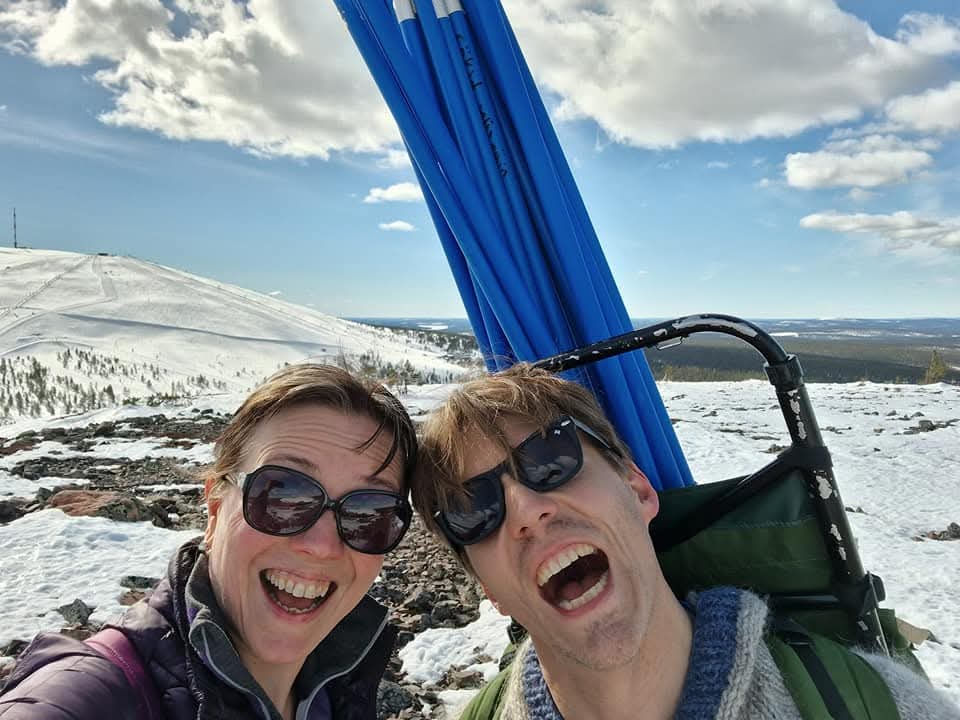
Us at Ylläs
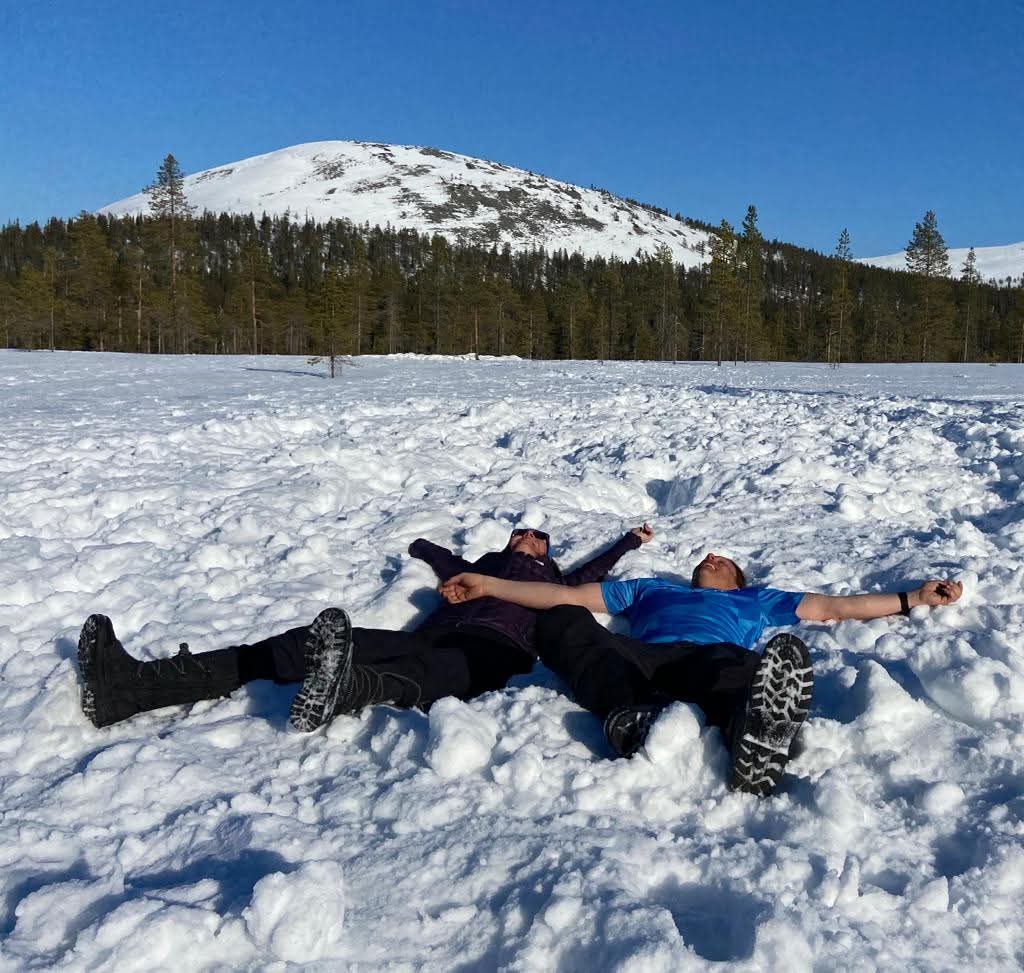
The relief after the first race
The core team
From the beginning, Sami—one of the Sikaniska group—has also been involved. In many situations, he has been the one who comes up with the craziest ideas—and actually carries them out as well. With just the right amount of humor.
One of the most legendary setups was the “ice cube machine” that appeared in Ylläs. It was a device used to lift blocks of ice out of the ice hole. In a winter race, an ice hole does not just appear. When the ice is over a meter thick, you do not simply open it with a shovel or an axe. Without heavy tools, it is practically impossible. Sami solved the problem by building his own contraption to lift ice blocks out of the hole. It looked as if someone had built an industrial machine in the middle of a fell landscape.
This kind of creativity has been part of the spirit of Winter Warrior from the very beginning.
I am especially grateful to my son and my daughter-in-law.
Over the years, they have become increasingly involved also in the invisible work that organizing the event requires throughout the year. Their contribution has been immensely important to us.
Along the way, there have also been many others: friends, volunteers, and partners. Without them, this event would never have come to life.
I will not start listing everyone here, but we are grateful to everyone who has, in one way or another, been part of building Winter Warrior.
Surprisingly many people have assumed that this is our job. Recently, someone asked me what we plan to do next. I replied that I intend to focus on my own hobbies for a change—and perhaps even take a holiday without long to-do lists.
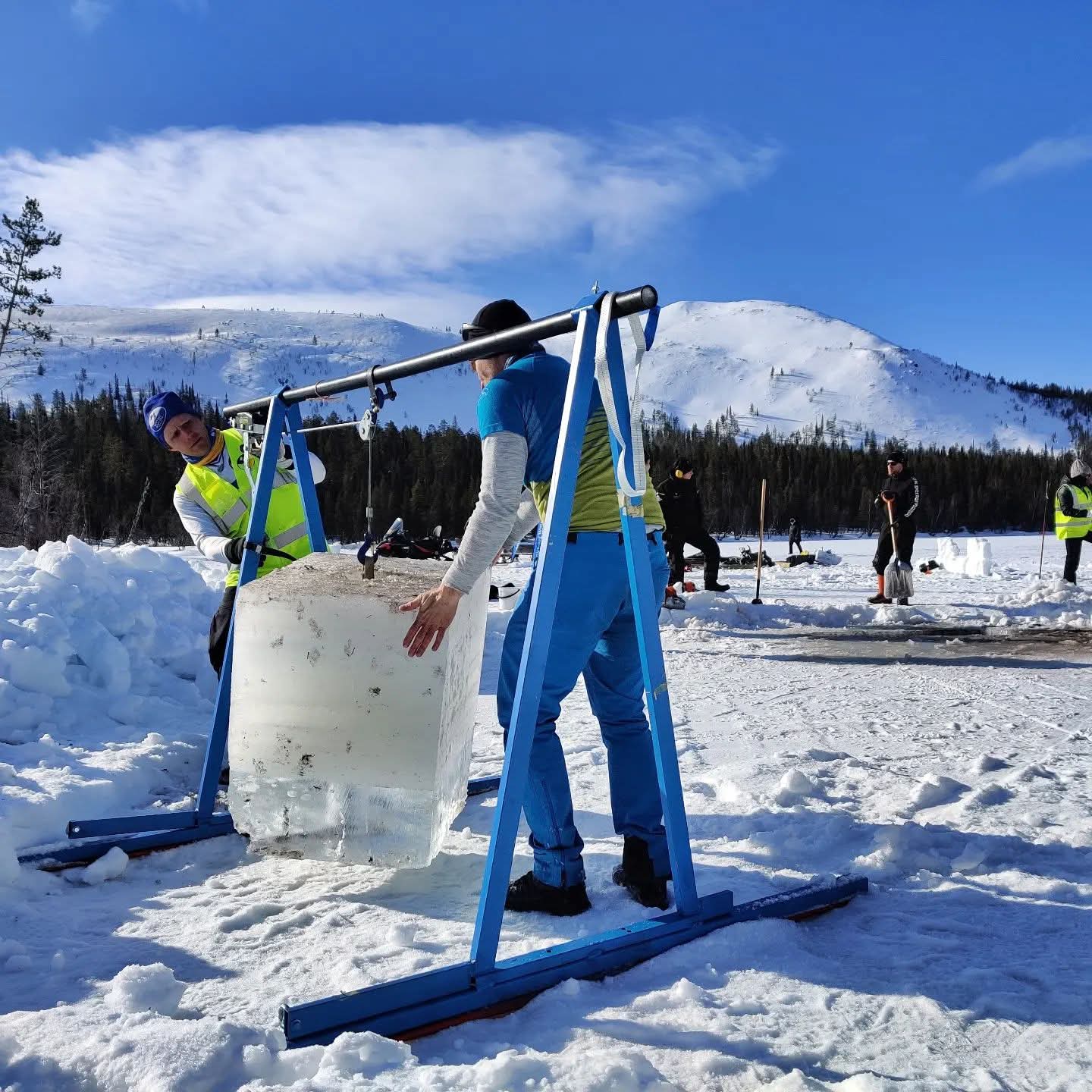
In the early years, the blocks were lifted using the previously mentioned device called the ‘Ice Cube Machine.’ It was a frame built on top of downhill skis and equipped with a manual winch. The device was slid next to the ice block, and the block was then winched up. In recent years, we’ve pulled the blocks up with a snowmobile, which turned out to be a much faster method.
Towing an ice cube after lifting.
Looking back
Sometimes I am asked whether I regret it. When you think about all the time, energy, and personal money that went into it, you might expect the answer to be yes. But the truth is, I do not really regret anything.
Winter Warrior has brought into my life an enormous number of people, experiences, and stories that would never otherwise have existed. I have seen people surpass their limits, seen volunteers work together completely selflessly, and seen how even a small event can mean surprisingly much to those who take part. It has also taught me a great deal about people. An event built on volunteer work does not function through orders, but through trust, enthusiasm, and the feeling that people are part of something shared.
And perhaps most importantly: I have learned that things do not have to be perfect to be meaningful.
If someone is ever wondering whether it is worth organizing an event like this, the answer is perhaps this: it is much harder than you can imagine beforehand, but at its best, it is also far more rewarding.
If I could go back to that moment when Simo came home from the Tough Guy Competition and started enthusiastically talking about how great it would be to organize something like this in Finland… I would probably answer exactly the same way as I did then:
“Well, let’s do it.”
Over these years, the event has been much more to us than just a race. It has been a shared project, an adventure, and an immense amount of work done together. You never know what the future holds; we tend to get excited about things. But at least in this form, this was the final chapter of the story.
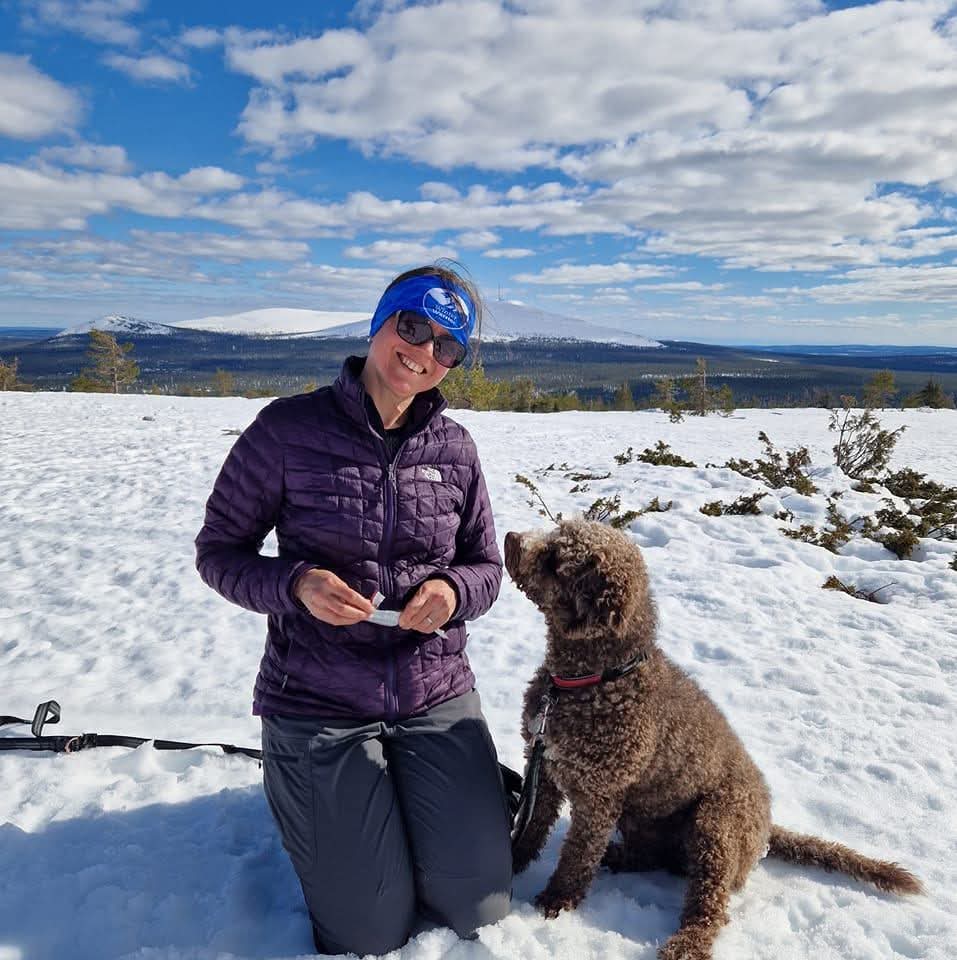
Me and the official race mascot Obelix
Contact
Winter Warrior Finland
winterwarriorfinland@gmail.com
Useful links